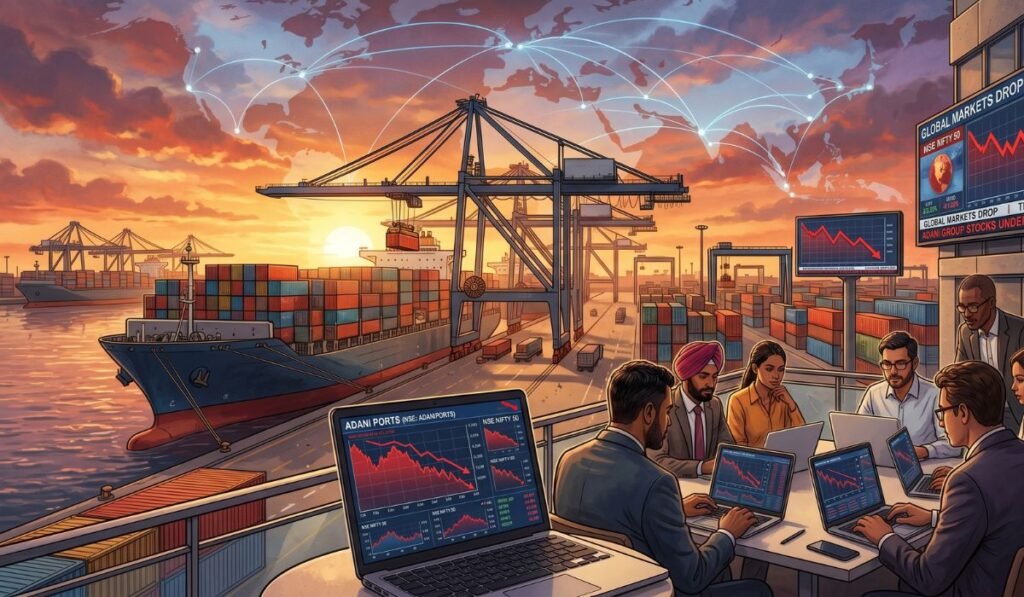
Adani Ports Share Price Falling 2026
Adani Ports Share Price Falling 2026
US tariffs, Iran war impact, DOJ indictment overhang, FII selling explained, Q3 FY26 results decoded, and Macquarie’s 27% upside target — everything in one place
There is a stock that handles 27% of India’s entire cargo volume. It operates 15 ports across India’s coastline, runs 129 vessels, manages 12 multi-modal logistics parks, and recently acquired a terminal in Australia. Its quarterly revenue crossed ₹9,700 crore. Its business has never been stronger on paper.
And yet, in April 2026, investors are watching it fall — and asking why.
Adani Ports and Special Economic Zone Limited. NSE: ADANIPORTS. BSE: 532921.
The stock hit a 52-week high of ₹1,584 on February 9, 2026, and has since slipped 11.32% amid broader market correction. Business Today As recently as April 14, the stock declined up to 3.54% intraday, making a low of ₹1,422.75. Trade Brains For investors who bought near the top, that is a painful gap to sit with.
But here is the thing — the decline in Adani Ports share price is not random. There are specific, identifiable reasons driving it. And understanding those reasons is the difference between panicking and making an informed decision. Here is the full picture.
What Adani Ports Actually Is — Before We Talk About Why It Is Falling
Most investors know the Adani name. Fewer understand just how dominant Adani Ports is as an infrastructure business.
Adani Ports and Special Economic Zone is India’s largest private port operator and an integrated transport utility, handling roughly 27% of India’s total cargo. The company operates 15 strategically located ports and terminals across India’s west, south, and east coasts, combined with a diversified marine fleet of 129 vessels, integrated logistics capabilities including 12 multi-modal logistics parks, 3.1 million sq. ft. of warehouses, and 25,000+ trucks operating on its proprietary platform. Trade Brains
The company also operates 4 international ports across Australia, Colombo, Israel, and Tanzania, with a current cargo handling capacity of 653 million tonnes per annum — targeting 1 billion tonnes. Trade Brains
This is genuinely irreplaceable infrastructure. Ports cannot be replicated overnight. The cargo volumes flowing through Adani Ports are tied to India’s economic growth, not a discretionary product cycle. So when a business this strong is falling, the reasons are almost always external — and in 2026, there are several stacking up at once.
Adani Ports Share Price — April 2026 Key Data
| Parameter | Value |
|---|---|
| 52-Week High | ₹1,584 (Feb 9, 2026) |
| Recent Low (Apr 14) | ₹1,422.75 |
| 52-Week Low | ₹1,041.05 (Apr 7, 2025) |
| Market Cap | ₹3.02 lakh crore+ |
| FII Holding | 20.4% |
| DII Holding | 12.4% |
| RSI | ~37.7 (neutral zone) |
| Analyst Target (Macquarie) | ₹1,820 — 27% upside |
Reason 1 — The US-Israel-Iran War and the Strait of Hormuz Scare
This is the most immediate trigger for the recent sell-off — and it is one that affects the entire shipping and port sector globally, not just Adani.
The ongoing conflict involving the US, Israel, and Iran has raised serious fears about the Strait of Hormuz — the narrow waterway through which a significant portion of the world’s crude oil and LNG passes. Any disruption there means shipping delays, higher freight costs, and reduced cargo volumes at ports exposed to liquid cargo.
The stock has slipped 11.32% amid market correction due to the ongoing war between the US-Israel and Iran. Business Today
However — and this is important for investors to understand — Adani Ports’ exposure to the Strait of Hormuz crisis is relatively limited, with liquid cargo accounting for less than 10% of total volumes. Within this category, crude oil handling accounted for just 5% in the first nine months of FY26, while gas volumes represent a small 2% portion. Business Today
In plain terms: the market has sold Adani Ports as if it were a pure liquid cargo play. It is not. The fear is real but the actual financial exposure is limited. This kind of sentiment-driven selling — where the price falls more than the fundamentals justify — is exactly what creates opportunity for long-term investors, provided the other risks are manageable.
Reason 2 — The US 26% Reciprocal Tariff Shock of April 2, 2026
On April 2, 2026, the United States announced a 26% reciprocal tariff on Indian goods. The announcement sent shockwaves through Indian equity markets — and the Adani Group, with its exposure to export-linked businesses, took a disproportionate hit.
Following the US reciprocal tariff announcement, the stock fell 8% in three sessions. Bernstein and CLSA subsequently cut their FY27-28 earnings estimates, citing the impact on green hydrogen export economics and broader Adani Group growth timelines. Univest
For Adani Ports specifically, the tariff impact is indirect — a slowdown in Indian exports would reduce container volumes flowing through its ports over time. It is not an immediate earnings hit, but it changes the growth trajectory assumptions that had been baked into the stock’s premium valuation.
The market does not wait for actual earnings impact to arrive. It reprices the moment the risk becomes visible. That repricing is what you are seeing in the share price right now.
Reason 3 — The US DOJ Indictment Overhang That Will Not Go Away
This is the one factor that has structurally changed how foreign institutional investors look at the entire Adani Group — and it did not start in 2026.
The US Department of Justice’s indictment of Gautam Adani and other Adani Group executives in November 2024, alleging involvement in a bribery scheme related to solar energy contracts, created the single largest overhang on Adani Group stocks. While SEBI’s investigation concluded without major findings against the Group, short-sellers continue to monitor and publish research on Adani stocks — meaning any fresh report with credible allegations would trigger another sharp sell-off. Univest
The DOJ indictment is not resolved. It is not going away quietly. And in every period of global market stress — like right now, with the Iran conflict and US tariff uncertainty — investors reduce exposure to stocks that carry unresolved legal and governance risk. Adani Ports, despite being the most operationally sound business in the Adani Group, carries this group-level overhang whether it deserves it individually or not.
Adani Group relies on international bond markets for a significant portion of its long-term funding. If the US DOJ indictment leads to cross-default clauses being triggered, or if international bond investors refuse to roll over existing bonds at reasonable rates, it would create a funding risk across the Group. Univest
This is the scenario that keeps institutional risk managers cautious — not the day-to-day port volumes.
Reason 4 — FII Selling in a Global Risk-Off Environment
Adani Ports has one of the highest FII ownership levels in the Adani Group. That is normally a sign of confidence. In a risk-off environment, it becomes a liability.
With 20.4% FII holding, Adani Ports is highly sensitive to global risk-off events — FII selling can be disproportionate to any specific negative news. Univest
When global funds go into risk-reduction mode — triggered by geopolitical conflict, tariff shocks, or currency volatility — they do not always make nuanced distinctions between a great business with governance overhang and a genuinely troubled company. They sell what they can sell, and Adani Ports, with its high FII ownership and high beta of 1.24, is exactly the kind of stock that gets sold first.
The Adani Group stock has seen high volatility in the last one year with its beta at 1.24. The stock is currently trading below its 10-day, 20-day, 30-day, 50-day, 100-day, 150-day, and 200-day moving averages. Business Today
When a stock is below every meaningful moving average, it tells you that sellers have been consistently in control across every time frame. That is the technical picture ADANIPORTS is in right now.
Reason 5 — The Broader Adani Conglomerate Discount
There is a fifth factor that does not get discussed enough — the conglomerate discount.
Adani Group’s business incubation model requires patient capital and long gestation periods before new businesses generate returns. Until cash flow from mature businesses — ports, power transmission, gas distribution — comfortably covers debt service across the group, the leverage overhang persists. Univest
In good times, being part of the Adani Group gives a stock a premium — the brand, the political capital, the infrastructure pipeline. In risk-off times, the same association becomes a discount. Investors who are uncertain about one part of the Adani Group ecosystem reduce exposure across all parts — including Adani Ports, even though its own balance sheet and cash flows are healthy.
This is the conglomerate paradox. The best business in a group sometimes suffers the most during a group-wide selloff, simply because it is the most liquid and the most institutionally owned.
What the Business Actually Delivered — Q3 FY26 Results
Here is where the disconnect between the share price and the fundamentals becomes very clear.
In Q3 FY26, Adani Ports showed significant revenue growth across all segments. Domestic ports revenue rose from ₹5,826 crore to ₹6,701 crore year-on-year. International ports grew from ₹885 crore to ₹1,067 crore. Logistics revenue nearly doubled from ₹693 crore to ₹1,121 crore. Marine revenue jumped from ₹406 crore to ₹773 crore. Total revenue grew from ₹7,964 crore in Q3 FY25 to ₹9,705 crore in Q3 FY26. Trade Brains
That is 22% revenue growth. Logistics revenue almost doubled. Marine revenue nearly doubled. These are not the numbers of a business in trouble — these are the numbers of a business firing on all cylinders operationally.
The falling share price is not telling you the business is deteriorating. It is telling you that external fears — geopolitical, legal, macro — are weighing on a fundamentally strong stock.
What Analysts Are Saying — The Macquarie Buy Call
Despite the decline, not everyone is running for the exit. In fact, the most recent high-profile analyst note went in the opposite direction entirely.
Macquarie has maintained a Buy rating on Adani Ports with an upside potential of 27% from recent levels. Growth is driven by strong volume expansion, international diversification, and the NQXT acquisition. The consolidation of the North Queensland Export Terminal adds approximately 40 MMT of contracted capacity, significantly expanding Adani Ports’ international footprint and improving long-term volume stability. Trade Brains
Higher coal volumes, supported by the restart of Tata Power’s Mundra plant, are expected to offset domestic container weakness. FY26 estimates suggest approximately 18% revenue growth and 6% EBITDA growth. Strong cash generation is expected to reduce net debt-to-EBITDA over time. Trade Brains
Motilal Oswal has also given a Buy rating with a target price of ₹1,820 — implying 39% upside from the March 31 market price of ₹1,313. Business Today
Two major brokerages, both with Buy ratings, both implying 27–39% upside. That is not the picture of a stock the institutional world has given up on. It is the picture of a stock that is temporarily dislocated from its fair value by external factors.
Should You Buy, Hold, or Wait?
This article does not provide investment recommendations — and the volatility around Adani Ports right now means anyone giving you a confident short-term answer should be approached with caution. What the data does tell you clearly is this:
The business is growing. Revenue is up 22% year-on-year. The NQXT acquisition adds global diversification. The Strait of Hormuz exposure is smaller than the market fears. But the governance overhang from the DOJ indictment is real, the tariff environment is uncertain, and the technical picture — below every moving average — suggests the sellers are still in control in the near term.
Adani Ports at current levels is considered the highest-quality asset in the Adani Group at its most attractive valuation. The port and logistics business is genuinely world-class — consistent cash flows, irreplaceable infrastructure, growing India trade volumes. Univest
For long-term investors, the gap between what the business delivers and what the price implies is becoming harder to ignore. For traders, the trend is still down until the macro headwinds — tariffs, Iran conflict, DOJ resolution — show signs of clearing.
The port handles 27% of India’s cargo. India’s trade is not stopping. That equation, eventually, reasserts itself.
Track Adani Ports Share Price
- NSE Symbol: ADANIPORTS
- BSE Code: 532921
- Official website: adaniports.com
- Real-time price: nseindia.com or bseindia.com
Disclaimer: This article is for informational and educational purposes only. It does not constitute financial advice or a buy/sell recommendation. Stock prices are volatile and subject to market risk. Always consult a SEBI-registered financial advisor before making investment decisions. Past performance is not indicative of future results.