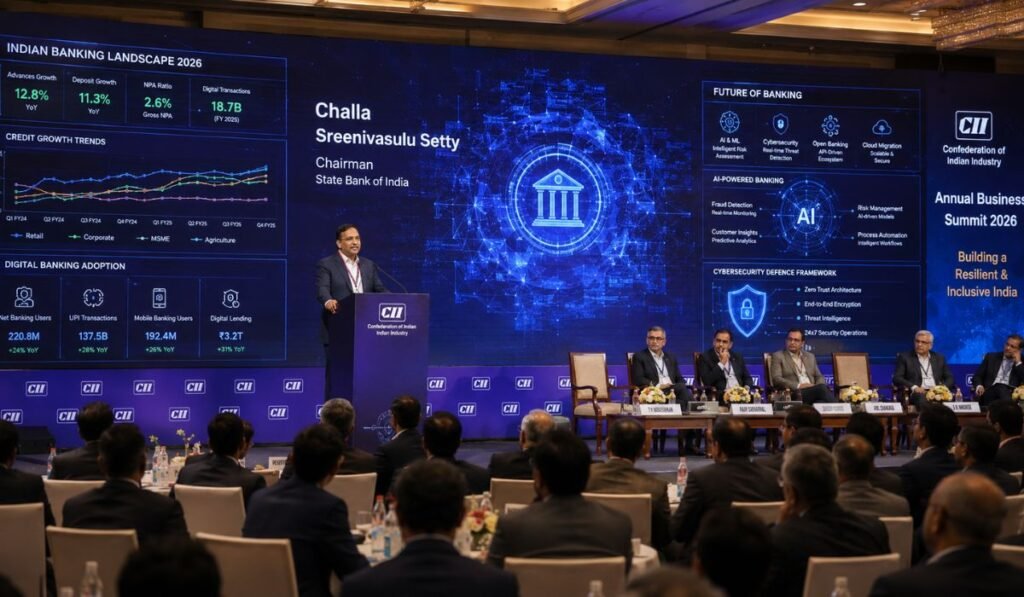
SBI Chairman CS Setty at CII Summit
Full CII Annual Business Summit speech decoded, cyber risk vs algorithmic bias explained, 90% deposit-built balance sheet problem, ₹600 lakh crore by 2035 mobilisation gap, bond market deepening call, and what it means for every Indian bank customer and investor — everything in one place
On Monday, May 11, 2026, the chairman of India’s largest bank walked into the CII Annual Business Summit and said something that every Indian with a bank account, a digital wallet, or a UPI-linked investment needs to hear.
Challa Sreenivasulu Setty — CS Setty — the Chairman of State Bank of India, the man who oversees a balance sheet larger than the GDP of most countries, looked at a room full of India’s top business leaders and delivered a clear, unambiguous warning.
SBI Chairman CS Setty at CII Summit
Speaking at the CII Annual Business Summit during a session on “The Future of Financing,” Setty said banks and financial institutions would need to strengthen governance frameworks, capital buffers, cybersecurity capabilities and risk management systems as the banking sector undergoes technological transformation. He said India’s financial architecture would have to remain resilient while expanding digital financial services and formal credit access across sectors. Business Today
This was not a routine regulatory speech. This was India’s most important banker — speaking from inside the institution that manages more than ₹60 lakh crore in deposits — telling the country that the very speed and scale of India’s digital finance revolution is creating risks that the system is not yet equipped to handle.
SBI Chairman CS Setty at CII Summit
Here is the complete breakdown of what CS Setty said, why it matters, and what it means for every segment of India’s financial ecosystem.
Who Is CS Setty — And Why His Warning Carries Weight
SBI Chairman CS Setty at CII Summit
Before unpacking the speech, understanding who delivered it matters enormously.
Challa Sreenivasulu Setty is the Chairman of State Bank of India — a Maharatna PSU that manages over 50 crore accounts, operates more than 22,000 branches across India, and has a loan book exceeding ₹37 lakh crore. SBI is not just India’s largest bank — it is the backbone of the Indian financial system. When the SBI Chairman speaks at the CII Annual Business Summit, he is not speaking as one banker among many. He is speaking as the custodian of India’s financial stability.
SBI Chairman CS Setty at CII Summit
The CII Annual Business Summit 2026 brought together leaders to shape a resilient and inclusive future, charting India’s journey towards a globally competitive Viksit Bharat. The summit focused on three system enablers: governance that builds trust, strong state capacity, and robust financial architecture that mobilises long-term capital. India TV News
SBI Chairman CS Setty at CII Summit
In that context — India’s most important annual gathering of business leadership, focused on the Viksit Bharat 2047 vision — CS Setty chose to spend his address not on SBI’s own performance or India’s growth story, but on warning about the vulnerabilities that rapid digital finance growth is creating. That choice of subject, at that platform, is itself a signal about how seriously the banking establishment views these risks.
The Central Warning — “Innovation Without Trust Cannot Sustain Itself”
SBI Chairman CS Setty at CII Summit
Setty warned that rapid growth in digital finance, platform lending and artificial intelligence-driven underwriting is creating new vulnerabilities in the financial system. The increasing use of digital finance and AI-based underwriting has created opportunities for faster credit delivery and wider financial inclusion, but it has also introduced fresh risks. Trade Brains
SBI Chairman CS Setty at CII Summit
Setty said: “As India’s financial system expands in scale and complexity, trust must remain its foundational principle. Innovation without trust cannot sustain itself. The rapid growth of digital finance, platform lending and AI-driven underwriting creates new opportunities but also new vulnerabilities.” India TV News
That single line — “Innovation without trust cannot sustain itself” — is the thesis of the entire speech. And it deserves unpacking carefully, because it is not a conservative banker’s resistance to technology. It is a specific, evidence-based concern about what happens when the speed of financial innovation outruns the speed of risk management and governance evolution.
SBI Chairman CS Setty at CII Summit
India’s UPI processes over 18 billion transactions per month. Digital lending apps have extended credit to millions who never had a formal loan before. Buy-now-pay-later products, AI-driven credit scoring, and platform-based insurance distribution have collectively expanded financial inclusion at a pace that would have seemed impossible a decade ago.
But speed creates its own vulnerabilities. And CS Setty named four of them explicitly.
Vulnerability 1 — Cyber Risk: The Invisible Threat Scaling With Every New User
SBI Chairman CS Setty at CII Summit
Setty warned that cyber risks, operational vulnerabilities, algorithmic biases and increasing systemic interconnectedness could pose significant challenges for banks and financial institutions if governance and risk management frameworks do not evolve alongside innovation. Univest
SBI Chairman CS Setty at CII Summit
Cyber risk is the most immediate and most visible of the four vulnerabilities Setty flagged. Every new UPI user, every new digital lending account, every new insurance app download is a new potential entry point for malicious actors. The attack surface of India’s financial system is expanding by millions of new endpoints every month.
The numbers behind this concern are significant. India is now among the top three targets globally for financial cyberattacks, according to multiple cybersecurity reports. The shift from branch-based banking to mobile-first banking has moved the security perimeter from a physical location — where guards, cameras, and human judgement provide a check — to a smartphone screen, where a convincing SMS or a spoofed app login can be enough to compromise an account.
SBI Chairman CS Setty at CII Summit
Setty said cyber threats and operational gaps could strain banks if controls lag behind innovation. He pointed to stronger governance, larger capital buffers, tighter cybersecurity and better risk controls. Univest
For SBI specifically — with over 50 crore account holders, many of whom are first-generation digital users in rural and semi-urban India — the cyber risk is not just a technology problem. It is a financial inclusion problem. A first-generation digital banking customer who loses their savings to a cyber fraud is not just a victim — they are potentially lost to the formal financial system permanently, reverting to cash and informal channels. That reversion undermines the entire financial inclusion project that took decades to build.
Vulnerability 2 — Operational Vulnerabilities: When Systems Scale Faster Than Controls
SBI Chairman CS Setty at CII Summit
Setty cautioned that cyber threats, operational vulnerabilities, algorithmic bias and growing interconnectedness within the financial system could create significant challenges for banks if governance systems do not evolve alongside innovation. Trade Brains
SBI Chairman CS Setty at CII Summit
Operational vulnerabilities are distinct from cyber attacks. They refer to the internal systems, processes, and controls within financial institutions failing to keep pace with the scale and speed of digital transactions.
Consider what happened during India’s demonetisation in 2016 — ATM queues, bank system crashes, UPI outages. Or the periodic outages that hit even large digital payment platforms during peak festival transaction periods. These are operational vulnerability moments — when the volume of transactions or the complexity of interconnected systems exceeds the capacity of the infrastructure designed to support them.
SBI Chairman CS Setty at CII Summit
In 2026, the scale is orders of magnitude larger. UPI handles hundreds of millions of transactions daily. Core banking systems at large PSU banks are processing settlement volumes that their legacy technology stacks were not originally designed to handle. The gap between transaction speed — which is near-instantaneous for UPI — and reconciliation, grievance redressal, and fraud detection systems — which can take days — creates operational windows that bad actors exploit.
SBI Chairman CS Setty at CII Summit
Setty said banks and financial institutions must upgrade defences as technology reshapes banking. He pointed to stronger governance, larger capital buffers, tighter cybersecurity and better risk controls. He said India’s financial design must stay strong while change accelerates. Univest
SBI Chairman CS Setty at CII Summit
“Capital buffers” is a phrase that often gets lost in policy speeches. In this context, it is specifically important. Capital buffers are the financial shock absorbers that allow banks to absorb losses — from fraud, from operational failures, from credit events — without threatening depositor funds. As digital finance scales, the potential magnitude of a single operational failure event scales with it. A bank that processes 10 crore digital transactions per day and experiences a system failure for four hours has a potential fraud exposure that would have been inconceivable in a branch-banking era.
Vulnerability 3 — Algorithmic Bias: The Credit Discrimination Nobody Can See
SBI Chairman CS Setty at CII Summit
This is the vulnerability that most commentators skip — and it may be the most structurally damaging of the four.
SBI Chairman CS Setty highlighted the dual nature of digital finance growth, noting both opportunities and vulnerabilities like cyber risks and algorithmic biases. Business Standard
SBI Chairman CS Setty at CII Summit
Algorithmic bias in financial services occurs when AI and machine learning models used for credit decisions — loan approvals, interest rate setting, credit limit assignment, insurance premium calculation — systematically disadvantage certain groups of customers based on patterns in historical data that reflect past discrimination, not actual creditworthiness.
SBI Chairman CS Setty at CII Summit
Here is a concrete example. An AI model trained on historical loan repayment data might learn that borrowers from certain pin codes, with certain educational qualifications, or with certain types of employment have higher default rates. If those historical patterns themselves reflect past discriminatory lending — where formal credit was systematically denied to certain communities, creating a self-fulfilling cycle of lower credit scores — the AI model will perpetuate and amplify that discrimination. It does so invisibly, at scale, without any individual loan officer making a conscious discriminatory decision.
SBI Chairman CS Setty at CII Summit
In India’s context, this is an extraordinarily consequential risk. The entire proposition of AI-driven digital lending is that it can extend credit to customers who were excluded from formal banking — because the AI can find creditworthiness signals in non-traditional data sources like mobile phone usage, utility payments, and social graph data. If the AI models are biased — and there is substantial evidence from global markets that they often are — then India’s digital lending revolution could end up replicating and amplifying the financial exclusion it was supposed to solve.
SBI Chairman CS Setty at CII Summit
CS Setty’s explicit flagging of algorithmic bias — in a speech focused on the future of financing — signals that India’s banking regulator and banking establishment are aware of this risk and taking it seriously.
Vulnerability 4 — Systemic Interconnectedness: The “Too Connected to Fail” Problem
SBI Chairman CS Setty at CII Summit
Setty warned that increasing systemic interconnectedness could pose significant challenges for banks and financial institutions if governance and risk management frameworks do not evolve alongside innovation. Univest
SBI Chairman CS Setty at CII Summit
Systemic interconnectedness is the “too connected to fail” problem for the digital age. In traditional banking, a failure at one institution — a bank run, a fraud, a credit collapse — could be contained because the linkages between institutions were limited and visible. Regulators could see the exposure and manage the contagion.
In India’s digital financial ecosystem in 2026, the interconnectedness is vastly more complex. A single UPI payment rail connects 500+ banks. A single fintech platform may have lending partnerships with 20+ NBFCs and banks simultaneously. A single data aggregator through Account Aggregator framework may hold financial data from 100+ institutions. A single cloud provider may host the core banking systems of multiple banks and financial service companies simultaneously.
SBI Chairman CS Setty at CII Summit
In this environment, a failure at any one node — a major fintech platform going down, a cloud provider experiencing an outage, a settlement system faltering — can cascade through the entire ecosystem in minutes. The very integration that makes India’s digital financial system efficient is also what makes it fragile.
Setty said banks and financial institutions must continue strengthening governance frameworks, capital buffers, cybersecurity capabilities and risk management systems. He said as the banking system undergoes technological transformation, India’s financial architecture would have to remain resilient with trust embedded in all innovation. Business Today
SBI Chairman CS Setty at CII Summit
The phrase “trust embedded in all innovation” is the key policy prescription. It means that risk assessment, governance oversight, and consumer protection mechanisms must be built into digital financial products from their inception — not added as an afterthought after problems emerge. This is a fundamental shift from the “move fast and fix later” approach that has characterised much of global fintech development.
The 90% Deposit Problem — Why Banks Cannot Fund India’s Future Alone
SBI Chairman CS Setty at CII Summit
Beyond the four specific vulnerabilities, CS Setty made a second major argument at the CII Summit that received less attention but carries equal long-term significance.
Setty said banks alone would not be able to finance India’s long-term development needs and called for deeper bond markets and greater participation from mutual funds, pension funds and insurance companies. “90 per cent of bank balance sheets today are built through deposits. But the nature of savings flows is changing,” he said, noting that household financial savings were increasingly moving towards mutual funds, insurance and retirement products. Univest
SBI Chairman CS Setty at CII Summit
This is a structural observation about India’s financial architecture that gets to the heart of how the country will fund its development ambitions. Banks fund themselves through deposits. Deposits are short-term liabilities — most Indians keep savings in accounts that can be withdrawn within days. But India’s infrastructure projects — roads, ports, railways, power plants — have 20 to 30-year gestation periods.
The mismatch between the short-term nature of bank deposits and the long-term nature of infrastructure financing needs is not new. What is new is that the mismatch is widening. Indian households are diversifying their savings away from bank deposits — into mutual funds, SIPs, insurance products, and National Pension System accounts. The share of household financial savings going into bank deposits has been declining steadily.
Setty said public capital expenditure had acted as a major catalyst for private investment, pointing to the rise in government capital spending from about ₹2 trillion in 2014-15 to a budgeted ₹12.2 lakh crore in 2026-27. According to Setty, institutions such as the National Bank for Financing Infrastructure and Development and the National Investment and Infrastructure Fund, along with instruments such as infrastructure investment trusts and REITs, were helping deepen India’s infrastructure financing ecosystem. Univest
The numbers Setty cited paint the picture of how dramatically India’s infrastructure financing ambition has scaled. Government CapEx went from ₹2 lakh crore in 2014-15 to ₹12.2 lakh crore in 2026-27 — a six-fold increase in 12 years. As covered in our detailed article on the Finance Department of India 2026, this CapEx scaling is the government’s primary economic growth lever. But the government cannot fund everything — and as the CapEx numbers grow, the need for complementary private capital becomes more urgent.
The ₹3,500 Lakh Crore Gap — India’s Most Important Number
SBI Chairman CS Setty at CII Summit
The SBI chairman said India would need massive capital mobilisation to achieve the Viksit Bharat goal by 2047, with estimates suggesting investment requirements of ₹3,000 lakh crore to ₹3,500 lakh crore over the coming decades. Around ₹600 lakh crore to ₹650 lakh crore would need to be mobilised by 2035 alone. India TV News
₹3,000 to ₹3,500 lakh crore. That is ₹3,000 trillion to ₹3,500 trillion rupees — or approximately $35 to $40 trillion at current exchange rates. This is the estimated total investment India needs to make over the next two decades to achieve the Viksit Bharat — developed India — vision by 2047.
To put this in context: India’s current GDP is approximately ₹350 lakh crore. The investment requirement represents 10 times India’s current annual GDP. Spread over 20 years, it requires annual investment of ₹150–175 lakh crore — approximately half of current GDP every single year.
No country in history has financed development at this scale and speed through bank deposits alone. The implication of Setty’s warning is explicit: India needs to fundamentally transform its capital markets — deepening the bond market, expanding pension fund participation in infrastructure, growing insurance premium pools that can fund long-term assets, and developing new instruments like InvITs and REITs — to channel household savings efficiently into productive investment.
Setty said banks alone would not be able to finance India’s long-term development needs and called for deeper bond markets and greater participation from mutual funds, pension funds and insurance companies. Univest
This call for deeper bond markets connects directly to the investment opportunity covered in our complete guide to bond investing in India 2026. The RBI Retail Direct platform, corporate bond platforms, and tax-free bonds from infrastructure entities are the retail investment instruments at the front end of the bond market deepening that Setty is calling for. When India’s bond market deepens, retail investors benefit — through better liquidity, more product options, and higher confidence in the fixed income ecosystem.
“Speed Must Never Come at the Cost of Safety” — The Policy Prescription
SBI Chairman CS Setty at CII Summit
Having diagnosed the vulnerabilities, CS Setty offered a clear prescription.
Setty stressed that maintaining public confidence would remain essential as more consumers and businesses enter the formal financial system. “Speed must never come at the cost of safety, and innovation must never undermine inclusion,” he said, adding that customers must continue to feel secure about the integrity of the financial system. Trade Brains
“Ultimately, the Indian customer must continue to feel secure and confident in the integrity of our financial system. That confidence is our greatest institutional asset,” Setty said. Univest
The phrase “greatest institutional asset” applied to customer confidence is not rhetorical. It is an economic statement. India’s banking system holds over ₹200 lakh crore in deposits. That money stays in banks because Indian depositors trust that their money is safe. That trust — built over decades of the Deposit Insurance and Credit Guarantee Corporation framework, the RBI’s regulatory oversight, and the government’s implicit backing of PSU banks — is the single most valuable thing the Indian financial system possesses.
If a major cyber fraud event, a platform lending collapse, or an algorithmic discrimination scandal were to seriously damage that trust — particularly among India’s newly-banked rural and semi-urban population — the consequences for financial inclusion would be severe and long-lasting. People who lose faith in digital finance revert to cash. Cash is exclusionary, inflationary, and opaque. Rebuilding trust once lost is orders of magnitude harder than maintaining it.
This is why Setty’s warning is not conservative or anti-innovation. It is a plea for sustainable innovation — the kind that builds customer confidence as it scales, rather than eroding it.
What This Means for 5 Different Stakeholders
SBI Chairman CS Setty at CII Summit
For bank customers — individual depositors and borrowers: The speech is a signal that India’s banking regulators and banking leadership are aware of the cyber and operational risks you face as a digital banking user. Practically, this means the pressure on banks to invest in fraud detection, grievance redressal, and customer education will increase. It also means that if you receive a suspicious OTP, a too-good-to-be-true loan offer, or an unexpected account transaction — your right to speedy redressal is something the banking establishment is now publicly committed to protecting.
For fintech companies and platform lenders: Setty’s speech is a preview of where regulatory pressure will intensify in the next 12–24 months. The RBI’s existing directions on digital lending — which require transparency in loan pricing, prohibition of automatic debit mandates, and mandatory grievance redressal — are likely to be strengthened. Algorithmic bias testing requirements, similar to the Fair Lending Act frameworks in the United States, may be introduced. Fintechs that build compliance and consumer protection into their core product architecture now will be better positioned than those that treat it as an afterthought.
For investors in banking stocks: The operational and cyber risk vulnerabilities Setty described translate directly into potential future provisioning requirements for banks that experience large-scale fraud events or system failures. Banks that invest in cybersecurity, operational resilience, and algorithmic fairness now are making investments that reduce tail risk — even if those investments suppress near-term profitability. When evaluating banking stocks — from SBI to Jana Small Finance Bank to Jio Financial Services — the governance and risk management framework is as important as the NIM and GNPA metrics.
For bond market participants and fixed income investors: Setty’s explicit call for deeper bond markets — with more participation from mutual funds, pension funds, and insurance companies — is a policy signal that the government and banking establishment want the bond market to play a larger role in financing India’s growth. This is positive for retail bond investors who have access to the RBI Retail Direct platform. As covered in our guide to bond investing in India 2026, G-Secs and corporate bonds will become more liquid and accessible as the market deepens. The InvIT and REIT instruments Setty mentioned are also worth understanding — they allow retail investors to participate in infrastructure financing with the liquidity of exchange-traded instruments.
For India’s unbanked and underbanked population: The most consequential stakeholder group in Setty’s speech is also the least represented in policy discussions. India still has hundreds of millions of people whose relationship with formal finance is new, fragile, and easily broken by a bad experience. Setty’s insistence that “innovation must never undermine inclusion” is a direct recognition that the pursuit of efficiency and profit in digital lending can — if not carefully managed — come at the expense of the most vulnerable borrowers. The algorithmic bias risk is particularly acute for first-generation borrowers from marginalised communities. If AI-driven underwriting systematically excludes them from credit based on biased historical data, the financial inclusion promise of digital finance is hollow.
The 3 Things India’s Banking System Must Do — Reading Between the Lines
SBI Chairman CS Setty at CII Summit
CS Setty’s speech, read carefully, contains three implicit calls to action — for regulators, banks, and the government collectively.
Accelerate cybersecurity investment across the entire banking system — not just at large private banks. The cyber risk is highest among smaller banks and cooperative banks whose technology infrastructure is least updated and whose customers are most vulnerable. A coordinated, RBI-mandated cybersecurity upgrade programme — with specific minimum standards for fraud detection, customer authentication, and incident response — is the logical next step.
Establish a regulatory framework for algorithmic fairness in financial services. India currently has no specific regulation requiring banks and fintechs to test their credit models for algorithmic bias. The RBI’s 2022 digital lending guidelines were an important step, but they do not address the bias risk explicitly. A framework similar to the US Community Reinvestment Act — requiring financial institutions to demonstrate that their digital credit decisions are not systematically discriminatory — would be a significant regulatory development.
Deepen the bond market with urgency and scale. Setty’s call for ₹600–650 lakh crore of capital mobilisation by 2035 requires a bond market that can efficiently channel household savings into long-term infrastructure assets. This means expanding the investor base for government securities through RBI Retail Direct, developing a liquid corporate bond market, creating standardised InvIT and REIT instruments, and building the credit rating and disclosure infrastructure that institutional investors need to confidently allocate to long-duration bonds.
SBI Q4 FY26 — The Institution Behind the Speech
SBI Chairman CS Setty at CII Summit May 2026
While the CII Summit speech dominated Monday’s headlines, it is worth noting that SBI simultaneously delivered a strong Q4 FY26 result that contextualises Setty’s position of authority.
SBI Q4 profit rises 6% to ₹19,684 crore as bad loans dwindle. A profit of ₹19,684 crore in a single quarter — with declining NPAs — gives CS Setty the institutional credibility to speak about financial system risks from a position of demonstrated stability, not crisis management. Business Today
The contrast is instructive. SBI, under Setty’s leadership, has delivered consistent profitability, declining gross NPAs, and expanding digital banking penetration — while the chairman uses his platform to warn about the risks of moving too fast. This is not a banker resisting change. It is a banker who has successfully navigated change, warning that the rest of the system must build the same governance foundations that SBI has spent decades developing.
The One Line Every Indian Should Remember
SBI Chairman CS Setty at CII Summit May 2026
Of all the words spoken at the CII Annual Business Summit on May 11, 2026, one line from CS Setty’s speech captures the entire argument in 12 words:
“Speed must never come at the cost of safety and innovation must never undermine inclusion.” Univest
In those two clauses is the complete philosophy of responsible digital finance. Speed is good — it delivers credit faster, processes payments instantly, reduces friction. But if speed comes at the cost of cybersecurity, operational resilience, or consumer protection, the speed is not a feature. It is a vulnerability. Innovation is good — it extends credit to the previously excluded, prices risk more accurately, and delivers financial products at lower cost. But if innovation is built on biased algorithms or creates systemic risks that the excluded borrower cannot understand or contest, the innovation is not inclusion. It is a new form of exclusion.
India is at a critical inflection point in its financial development trajectory. The decisions made in the next three to five years — on cybersecurity investment, algorithmic governance, bond market deepening, and capital mobilisation architecture — will determine whether India’s ₹3,500 lakh crore Viksit Bharat ambition is achievable or aspirational.
CS Setty’s warning, delivered from the most authoritative financial platform in India, is the clearest signal yet that the banking establishment understands the stakes — and is asking the broader ecosystem to act accordingly.
Key Resources Referenced in CS Setty’s Speech
- RBI Retail Direct (bond market deepening): rbiretaildirect.org.in
- NABFID (National Bank for Financing Infrastructure and Development): nabfid.org
- NIIF (National Investment and Infrastructure Fund): niif.com
- InvIT and REIT listings: nseindia.com
- SBI official website: sbi.co.in
- CII Annual Business Summit 2026: ciiannualsession.in
Also Read:
- How to Invest in Bonds in India 2026: Complete Beginner’s Guide
- Finance Department of India 2026: Union Budget, Tax Rules and What It Means for Your Money
- Financial Transactions Requiring PAN in India 2026: Complete Updated List
- Jio Financial Services Share Price May 2026: Allianz JV, 48% PAT CAGR and the Ecosystem Story
- Jana Small Finance Bank 2026: 80% PAT Growth Guided, Record Disbursements
- ONGC Share Price May 2026: KG Basin Commissioning, Record Dividend and Analyst Targets
Disclaimer: This article is for informational and educational purposes only. All quotes and statements attributed to CS Setty are sourced from publicly available reports of his speech at the CII Annual Business Summit on May 11, 2026, as published by Business Standard, Outlook Business, and Outlook Money. This article does not constitute financial, legal, or investment advice. Always consult qualified professionals before making financial decisions.
TD Auto Finance Review 2026: How It Works, Charges, and What Customers Really Say