PRP Treatment for Hair 2026: The Complete India Guide
Step-by-step procedure explained, city-wise cost comparison from Delhi to Pune, PRP vs GFC vs hair transplant honest comparison, 4 to 6 session protocol decoded, what blood tests you need before starting, 5 real patient scenarios — everything in one place
You noticed it first in the shower drain. Then in your comb. Then in the mirror — a hairline that looked different from six months ago, a parting that seemed wider, a ponytail that felt thinner in your hand.
Hair loss is one of the most emotionally charged medical experiences a person can have. It is not life-threatening. But for millions of Indians — men and women alike — it quietly chips away at confidence, self-image, and the simple joy of looking in the mirror without anxiety.
And in 2026, there is a treatment that more and more dermatologists, trichologists, and hair restoration specialists are recommending before surgery, before expensive medication protocols, and before the hair loss becomes severe enough to limit options.
PRP therapy. Platelet-Rich Plasma treatment for hair.
PRP therapy for hair has been recognised as one of the most reliable non-surgical options with a range from early to moderate hair loss, even in 2026. Angelone
Here is the complete guide — from the science of how it works, to the exact cost in every major Indian city, to the honest success rate data, to the side effects nobody tells you about until you ask, to exactly who is a good candidate and who is not.
What Is PRP Treatment for Hair — The Science in Plain Language
PRP Treatment for Hair 2026: The Complete India Guide
PRP treatment is a non-surgical hair growth procedure involving injecting platelet concentration into the scalp. This stimulates blood supply to hair follicles and promotes new hair growth. The main intention of PRP treatment is to reduce hair loss and improve hair volume among those experiencing hair loss. NSE India
The science behind PRP is rooted in your own biology. Your blood contains four main components: red blood cells, white blood cells, platelets, and plasma. Platelets are not just clotting agents — they are biological powerhouses packed with Growth Factors: proteins that signal your body to repair tissue, build new blood vessels, and regenerate cells.
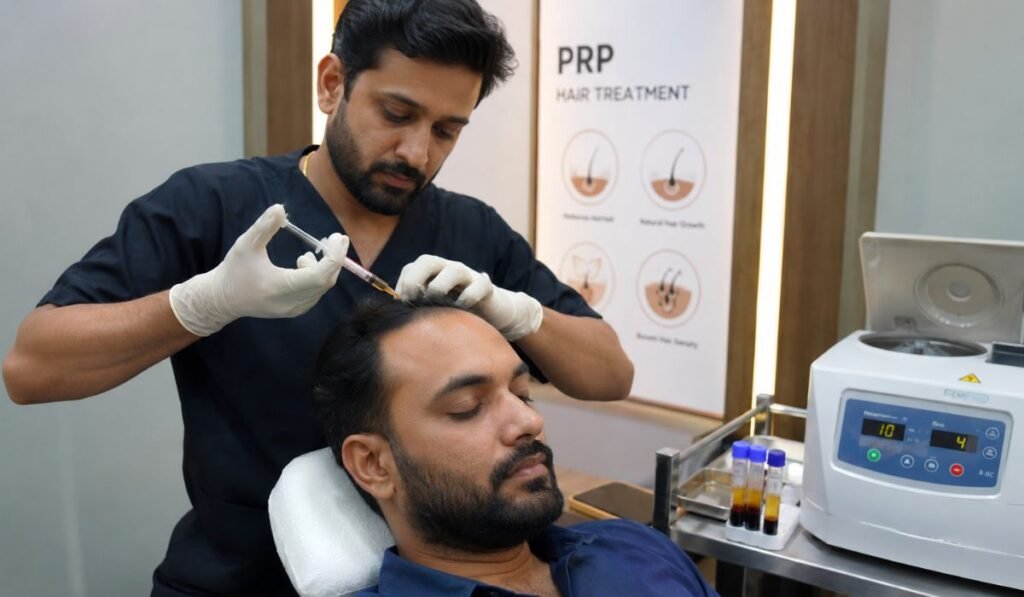
PRP therapy is a cutting-edge technique that rejuvenates the hair loss area by utilising the patient’s blood to trigger the natural process of hair formation. A tiny blood sample is taken, centrifuged to get the platelet-rich plasma, and then reintroduced to the skin of the head. Angelone
When this concentrated Growth Factor-rich plasma is injected directly into your scalp at the level of the hair follicles, it triggers a biological cascade: increased blood supply to dormant follicles, stimulation of follicle stem cells, reduction of the inflammation that accelerates hair loss, and activation of the growth phase of the hair cycle.
In practical terms — follicles that have been miniaturising or dormant begin to function again. Existing hair becomes thicker and stronger. New growth appears in areas of thinning. This is not a promise of a full head of hair where there is complete baldness. But for the 70 to 80 million Indians who have early to moderate hair loss — PRP can be a genuine, clinically validated turning point.
The Step-by-Step PRP Procedure — Exactly What Happens in the Clinic
PRP Treatment for Hair 2026: The Complete India Guide
This is what a typical PRP session looks like, from the moment you sit in the chair to the moment you walk out.
Step 1 — Blood Draw (5 minutes) A small amount of blood is taken from your arm — typically 10 to 20 ml, which is less than two teaspoons. This is done exactly like a routine blood test. No fasting required. No special preparation for most patients. Equitypandit
Step 2 — Centrifugation (10 to 15 minutes) The blood is spun in a centrifuge machine at high speed. This separates the blood into its components — the platelet-rich plasma rises to the top and is extracted separately from the red blood cells. The quality of this step — the centrifuge speed, the time, and the extraction technique — significantly affects how concentrated and effective the resulting PRP is. Premium clinics use medical-grade centrifuge systems that produce PRP with 4 to 6 times the normal platelet concentration. Budget clinics may use basic systems that produce lower concentrations — which affects results. Angelone
Step 3 — Scalp Preparation and Numbing (10 minutes) The scalp is cleaned with an antiseptic solution. A topical numbing cream is applied to the areas that will receive injections and left for 20 to 30 minutes. It feels like small pinpricks, but numbing cream helps significantly. For patients with low pain tolerance, some clinics also offer nerve blocks for additional comfort. Trendlyne
Step 4 — PRP Injection (20 to 30 minutes) The platelet-rich plasma is injected into the scalp at the areas affected by hair thinning or baldness using a thin needle. The injections are made at approximately 1 cm intervals across the treatment zone, at a depth of 4 to 6 mm — targeting the level of the hair follicle bulge where stem cells are located. ICICIdirect
Step 5 — Post-Treatment (5 minutes) The scalp is cleaned. The session is complete. The process takes about 60 to 90 minutes in total, and patients can usually return to their normal activities on the same day. No hospital admission. No bandages. No recovery period. ICICIdirect
PRP Treatment Cost in India 2026 — City-Wise Complete Breakdown
PRP Treatment for Hair 2026: The Complete India Guide
PRP hair treatment cost in India ranges from ₹3,000 to ₹12,000 per session. But that single range conceals significant variation based on city, clinic tier, technology used, and the experience of the treating doctor. Here is the complete picture. Yahoo Finance
Per Session Cost by Clinic Tier:
| Clinic Type | Cost Per Session | What You Get |
|---|---|---|
| Budget clinic / basic equipment | ₹3,000 – ₹4,500 | Basic centrifugation, standard protocol |
| Mid-range dermatology clinic | ₹5,000 – ₹8,000 | Standard PRP, experienced dermatologist |
| Premium / specialist hair clinic | ₹10,000 – ₹15,000 | Medical-grade centrifuge, trichologist, advanced protocol |
| Top-tier cosmetic surgery centres | ₹15,000 – ₹20,000 | Personalised protocol, highest platelet concentration |
City-Wise Cost Comparison:
PRP Treatment for Hair 2026: The Complete India Guide
Pune offers competitive pricing compared to other metropolitan cities in India, with PRP therapy costs ranging from ₹3,000 to ₹15,000 per session as of 2026. Equitypandit
PRP hair treatment cost in Delhi ranges from ₹5,000 to ₹20,000 per session. Screener
The cities of Delhi and Hyderabad have competitive prices because they have more dermatology and trichology centres with advanced technology. Angelone
| City | Per Session Range | Notes |
|---|---|---|
| Delhi / NCR | ₹5,000 – ₹20,000 | Most competitive market, highest clinic density |
| Mumbai | ₹7,000 – ₹20,000 | Premium areas like Bandra command highest prices |
| Hyderabad | ₹4,000 – ₹15,000 | Competitive pricing, growing specialist base |
| Bangalore | ₹5,000 – ₹18,000 | Strong corporate clientele drives premium pricing |
| Pune | ₹3,000 – ₹15,000 | Most affordable metro market |
| Chennai | ₹4,000 – ₹12,000 | Strong dermatology ecosystem |
| Jaipur / Tier-2 cities | ₹3,000 – ₹8,000 | Lower overhead, good quality available |
Total Treatment Cost — The Number That Actually Matters:
PRP Treatment for Hair 2026: The Complete India Guide
Most people need 3 to 6 sessions per year. So the yearly cost is usually between ₹15,000 to ₹50,000. Equitypandit
Most patients require 4 to 6 initial sessions for visible results. Total investment ranges from ₹18,000 to ₹90,000 for the initial treatment phase. Maintenance sessions every 6 to 12 months add to long-term costs. Annual maintenance typically costs ₹10,000 to ₹30,000 depending on session frequency. Equitypandit
The honest cost picture for a full PRP protocol in India in 2026:
- Initial phase (4 to 6 sessions): ₹20,000 to ₹90,000 depending on city and clinic tier
- Annual maintenance (1 to 2 sessions): ₹6,000 to ₹30,000 per year
- 3-year total investment: ₹35,000 to ₹1,50,000
Compared to a hair transplant — which costs ₹40,000 to ₹2,00,000 as a one-time procedure — PRP is cheaper in the short term but can approach transplant costs over 3 to 5 years of maintenance. The difference: PRP is non-surgical and reversible. A transplant is permanent and cannot be undone.
What Results Can You Actually Expect — The Honest Success Rate Data
PRP Treatment for Hair 2026: The Complete India Guide
PRP therapy success rates of 70 to 80% are reported in clinical studies for appropriate candidates. Equitypandit
That 70 to 80% figure deserves careful unpacking — because it is often misrepresented in clinic marketing.
70 to 80% success means that 70 to 80% of appropriate candidates see measurable improvement in hair density, thickness, or reduced hair fall after a complete PRP protocol. It does not mean 70 to 80% of people get a full head of hair back. And it specifically applies to appropriate candidates — which means people with early to moderate androgenetic alopecia, not advanced baldness.
What PRP can realistically deliver:
For early-stage hair loss (Grade 1 to 2 on the Norwood scale for men, Grade 1 to 3 on the Ludwig scale for women): PRP can significantly slow or halt progression, improve hair thickness by 20 to 40%, and stimulate regrowth in thinning areas.
For moderate hair loss (Grade 3 to 4): PRP reduces further loss, improves the health of existing hair, and provides modest regrowth. Results are meaningful but less dramatic than in early-stage patients.
For advanced baldness (Grade 5 and above): PRP cannot create new follicles where none exist. The follicles must be alive — even if dormant — for PRP to stimulate them. Advanced baldness with completely dead follicles does not respond to PRP.
Timeline of results:
PRP does not give instant results. It takes time and patience as it works through follicle health. Equitypandit
- Month 1 to 2: Reduced hair fall — the most common first result. Hair that was falling excessively begins to stabilise.
- Month 3 to 4: Existing hair appears thicker and stronger — the diameter of each hair shaft improves.
- Month 4 to 6: New growth begins to appear in thinning areas — fine, baby-hair growth that gradually thickens over subsequent months.
- Month 6 to 12: Maximum results from the initial protocol become visible.
Patience is not optional with PRP. Patients who abandon treatment after 2 sessions because they see no dramatic change are the ones who post negative reviews. The biological process of follicle reactivation takes months — not weeks.
The Blood Tests You Need Before Starting PRP
PRP Treatment for Hair 2026: The Complete India Guide
This is the section most clinic marketing skips completely — and it is critical for both safety and results.
Patients on anticoagulation therapy or with low platelet counts may not qualify. Blood test results help determine suitability. Equitypandit
Before any responsible clinic administers PRP, the following blood tests should be done:
Complete Blood Count (CBC): Checks your platelet count and overall blood health. PRP requires adequate platelet levels — patients with thrombocytopenia (low platelets) cannot produce effective PRP regardless of how sophisticated the centrifuge is.
Blood Glucose (Fasting): Uncontrolled diabetes significantly reduces PRP effectiveness. Elevated blood sugar impairs platelet function and growth factor activity.
Thyroid Function Test (TSH, T3, T4): Thyroid disorders — both hypothyroidism and hyperthyroidism — are a leading cause of hair loss in India, particularly in women. If your hair loss is thyroid-driven, PRP without treating the underlying thyroid condition will produce limited results.
Serum Ferritin (Iron Stores): Iron deficiency is the most commonly missed cause of hair loss in Indian women. Low ferritin — even without clinical anaemia — causes significant hair shedding. PRP on an iron-deficient patient is not wrong, but addressing the deficiency simultaneously dramatically improves results.
Hormonal Panel (for women): PCOS-related hormonal imbalance is a major driver of female pattern hair loss. A hormonal panel including testosterone, DHEA-S, prolactin, and LH/FSH helps identify whether hormonal treatment should be combined with PRP.
Any clinic that recommends PRP without reviewing these baseline investigations is prioritising speed over your best outcome. Insist on blood tests before committing to a protocol.
PRP vs GFC vs Hair Transplant — The Honest Comparison
PRP Treatment for Hair 2026: The Complete India Guide
Three treatments dominate the conversation around hair loss in India in 2026. Here is how they actually compare.
| Factor | PRP | GFC (Growth Factor Concentrate) | Hair Transplant (FUE) |
|---|---|---|---|
| What it is | Platelet-rich plasma injected into scalp | Higher concentration of growth factors extracted from blood | Surgical relocation of hair follicles from donor area |
| Invasiveness | Non-surgical | Non-surgical | Surgical |
| Cost (India) | ₹3,000–₹15,000/session | ₹6,000–₹20,000/session | ₹40,000–₹2,00,000 one-time |
| Sessions needed | 4–6 initial, maintenance every 6–12 months | 3–4 initial, maintenance every 6–12 months | Single procedure |
| Results timeline | 3–6 months | 3–6 months | 6–12 months for full growth |
| Success rate | 70–80% for appropriate candidates | 80–85% (higher growth factor concentration) | 90–95% for transplanted follicles |
| Works for advanced baldness | No | No | Yes |
| Works for early hair loss | Yes — ideal | Yes — ideal | Overkill, not recommended |
| Downtime | Zero | Zero | 7–10 days recovery |
| Permanence | Requires maintenance | Requires maintenance | Permanent for transplanted hair |
GFC vs PRP — The Key Difference:
PRP Treatment for Hair 2026: The Complete India Guide
GFC (Growth Factor Concentrate) is a more advanced version of PRP that is becoming popular in premium Indian clinics in 2026. While PRP contains platelets in plasma, GFC extracts and concentrates only the growth factors from those platelets — eliminating the plasma and other blood components that can cause inflammation. The result is a purer, higher-concentration growth factor solution.
GFC is more expensive than PRP but delivers higher growth factor concentration per injection — which some studies suggest produces marginally better results, particularly for patients who do not respond well to standard PRP. If your dermatologist offers both options, GFC is worth considering for the slightly higher cost if your clinic uses a validated GFC preparation system.
When is a hair transplant the right choice instead of PRP?
PRP Treatment for Hair 2026: The Complete India Guide
PRP cannot replace hair transplant. PRP is often used after hair transplant to keep hair healthy and improve graft survival. Equitypandit
A hair transplant is the right choice when: you have advanced baldness with completely bald areas where no follicles remain; you want a permanent one-time solution and are comfortable with surgery; or you have tried PRP for a complete protocol (minimum 4 sessions) without adequate results.
PRP and hair transplant are not competing treatments — they are complementary. Many hair transplant surgeons in India now recommend PRP sessions in the weeks before and after transplant surgery to improve graft survival and accelerate recovery.
Side Effects — What Nobody Tells You Until You Ask
PRP Treatment for Hair 2026: The Complete India Guide
PRP hair treatment is generally considered safe. However, there can be some potential side effects including redness and swelling at the injection sites, itching, and a burning sensation. In rare cases, infection, scarring, and changes in skin pigmentation have been reported. Screener
Here is the complete, honest side effect picture:
Common and Expected (resolve within 24 to 48 hours): Redness and warmth across the scalp — normal inflammatory response to the injections. Mild swelling — can occasionally move to the forehead or around the eyes the morning after treatment. Tenderness at injection sites — scalp soreness lasting 1 to 2 days. These are not complications — they are the expected biological response to the procedure.
Less Common (resolve within 1 week): Temporary increased hair shedding in the first 2 to 3 weeks after treatment. This is called a “shedding phase” — old, weakened hairs are pushed out as the follicles begin the growth cycle. It is alarming if you are not warned about it, and completely normal if you are. Do not stop treatment because of post-PRP shedding.
Rare (require medical attention): Infection at injection sites — extremely rare when sterile technique is used. Allergic reaction — almost impossible since PRP uses your own blood. Nerve damage from improper injection depth — this is why choosing a qualified dermatologist or trichologist is non-negotiable.
The most important side effect nobody mentions: Disappointment from unrealistic expectations. PRP is not a cure for hair loss. It is a management tool that works best in early stages, requires maintenance, and produces gradual rather than dramatic results. Clinics that overpromise set patients up for the most common and most damaging side effect: abandoning a treatment that would have worked, because the results did not match the marketing.
Who Should Get PRP — And Who Should Not
PRP Treatment for Hair 2026: The Complete India Guide
Ideal PRP candidates:
PRP Treatment for Hair 2026: The Complete India Guide
Early to moderate androgenetic alopecia (male or female pattern hair loss) — this is where PRP delivers its best results. Alopecia areata — patchy hair loss in autoimmune conditions — has shown positive response to PRP in multiple studies. Post-partum hair loss — the shedding that follows childbirth typically resolves on its own, but PRP can accelerate recovery and reduce the duration of the shedding phase. Hair thinning after stress or illness — telogen effluvium (stress-related hair loss) responds well to PRP when the underlying cause is also addressed. Pre and post hair transplant — PRP significantly improves graft survival when used 2 weeks before and 1 month after FUE transplant surgery.
Who should not get PRP:
PRP Treatment for Hair 2026: The Complete India Guide
Patients on anticoagulation therapy or with low platelet counts may not qualify. Blood thinners — aspirin, warfarin, clopidogrel — impair platelet function and reduce PRP effectiveness. Anyone with active scalp infection, skin cancer, or a blood disorder should not undergo PRP. Patients with uncontrolled diabetes should stabilise blood sugar before starting PRP. Pregnant women should wait until after delivery and breastfeeding. Anyone with a history of keloid scarring should discuss this with their doctor before proceeding. Equitypandit
The most important disqualification factor: Complete baldness with no surviving follicles. PRP reactivates dormant follicles — it cannot create follicles where none exist. A bald patch that has been completely smooth for more than 5 years typically has no viable follicles left to stimulate.
5 Real Patient Scenarios — PRP in Practice
PRP Treatment for Hair 2026: The Complete India Guide
Scenario 1 — 28-year-old woman with postpartum hair loss Six months after delivery, a software professional in Bengaluru notices her ponytail is half the thickness it used to be. Her dermatologist confirms telogen effluvium — stress-related shedding triggered by the hormonal shift of childbirth. Blood tests show low ferritin. The protocol: iron supplementation first, then 4 PRP sessions at monthly intervals. By month 5, her hair density is back to pre-pregnancy levels. Total cost: ₹32,000 across all sessions.
PRP Treatment for Hair 2026: The Complete India Guide
Scenario 2 — 35-year-old man with early androgenetic alopecia A marketing professional in Delhi notices a receding hairline and thinning at the crown — Grade 2 Norwood. He starts PRP at a mid-range dermatology clinic before the loss progresses further. After 6 sessions over 8 months, hair fall reduces significantly and density improves at the crown. He continues with maintenance sessions every 6 months. Total initial cost: ₹42,000. Annual maintenance: ₹12,000.
PRP Treatment for Hair 2026: The Complete India Guide
Scenario 3 — 45-year-old woman with PCOS-related hair loss A teacher in Jaipur with a history of PCOS has been experiencing progressive hair thinning for 3 years. Blood tests confirm elevated androgens. Her endocrinologist prescribes hormonal therapy simultaneously. Her dermatologist begins a PRP protocol — 5 sessions over 6 months. The combination of hormonal management and PRP halts progression and produces partial regrowth. PRP alone without addressing the underlying hormonal cause would have delivered limited results.
PRP Treatment for Hair 2026: The Complete India Guide
Scenario 4 — 52-year-old man considering hair transplant A retired officer in Mumbai with Grade 4 Norwood baldness wants a hair transplant. His surgeon recommends 3 PRP sessions before the procedure to strengthen existing hair and improve scalp vascularity, and then 2 sessions post-transplant to improve graft survival. The PRP adds ₹45,000 to the transplant cost but measurably improves the density and survival rate of transplanted follicles.
PRP Treatment for Hair 2026: The Complete India Guide
Scenario 5 — 22-year-old with alopecia areata A college student in Hyderabad develops two bald patches — a circular pattern typical of alopecia areata, an autoimmune condition. Her dermatologist confirms the diagnosis and recommends PRP alongside topical corticosteroids. After 4 sessions, the patches begin to show regrowth. By month 6, the patches are no longer visible. PRP is not a cure for alopecia areata, but it can induce remission in appropriate patients.
How to Choose the Right PRP Clinic in India — 6 Non-Negotiable Checks
PRP Treatment for Hair 2026: The Complete India Guide
Check doctor qualification. PRP should be administered by a qualified dermatologist (MD Dermatology) or trichologist — not a beautician, a general physician, or a clinic staff member. Ask directly: “Who will administer my PRP injection?” If the answer is not a qualified doctor, leave.
Ask about their centrifuge. The quality of PRP depends directly on the centrifuge. Ask: “What centrifuge system do you use and what platelet concentration does it achieve?” A clinic that cannot answer this question is not using medical-grade equipment.
PRP Treatment for Hair 2026: The Complete India Guide
Insist on blood tests before starting. Any clinic that wants to start PRP without baseline blood investigations is cutting corners. The blood tests described above — CBC, thyroid, ferritin, glucose — are not optional. They determine whether you are a suitable candidate and what concurrent treatment you may need.
PRP Treatment for Hair 2026: The Complete India Guide
Ask for before and after photographs of actual patients. Stock images and celebrity testimonials are marketing. Real patient photographs from the clinic’s own cases — shown with the patient’s permission — are evidence. Ask to see at least 5 to 10 cases comparable to yours.
PRP Treatment for Hair 2026: The Complete India Guide
Understand the complete cost before starting. The per-session price is just the starting number. Ask for the full protocol cost — how many sessions are recommended, at what interval, and what the maintenance schedule looks like. An unexpectedly long protocol or surprise additional charges are red flags.
PRP Treatment for Hair 2026: The Complete India Guide
Choose a clinic with a trichologist on staff. A trichologist — a specialist in hair and scalp health — brings diagnostic depth beyond what a general dermatologist offers for complex hair loss cases. Clinics with dedicated trichology practices tend to produce better patient selection and better outcomes than general skin clinics that offer PRP as one service among many.
PRP Treatment for Hair 2026: The Complete India Guide
Smart Tips — Getting the Best Results From Your PRP Protocol
PRP Treatment for Hair 2026: The Complete India Guide
Do not wash your hair on the day of treatment. Scalp oils provide a mild protective barrier. Arriving with clean, dry hair — washed the previous night — is ideal.
PRP Treatment for Hair 2026: The Complete India Guide
Avoid NSAIDs for 3 days before and after each session. Aspirin, ibuprofen, and other anti-inflammatory medications reduce platelet activity and directly counteract the PRP effect. Paracetamol is safe if you need pain relief.
PRP Treatment for Hair 2026: The Complete India Guide
Stay hydrated on treatment day. Dehydration affects blood viscosity and can make the blood draw more difficult. Drink 2 to 3 glasses of water before your appointment.
Do not colour or chemically treat your hair for 72 hours after PRP. Chemical processes — colouring, straightening, perming — can irritate the scalp during the post-injection recovery window.
Combine PRP with a medically appropriate hair supplement. Biotin, zinc, iron (if deficient), and amino acids support the follicle health that PRP stimulates. Your dermatologist can recommend a supplement protocol appropriate for your specific blood test results.
Take your photographs. On the day of your first session — before treatment — photograph your scalp from consistent angles in consistent lighting. Progress photographs at month 3 and month 6 are the only objective way to assess results, because hair changes are gradual and the human eye adapts to slow changes without registering them.
Find a Qualified PRP Provider
PRP Treatment for Hair 2026: The Complete India Guide
- Consult a dermatologist registered with the Indian Association of Dermatologists, Venereologists and Leprologists (IADVL): iadvl.org
- Verify doctor credentials: NMC register at nmc.org.in
- NABH-accredited clinics for quality assurance: nabh.co
Also Read:
- Hair Cutting Styles for Female 2026: 12 Trending Cuts and Face Shape Guide
- Financial Transactions Requiring PAN in India 2026: Complete Updated List
- How to Invest in Bonds in India 2026: Complete Beginner’s Guide
- Aadhar Housing Finance Share Price May 2026: 20% AUM Growth and Analyst Targets
Disclaimer: This article is for informational and educational purposes only. PRP treatment results vary significantly based on individual hair loss stage, underlying medical conditions, clinic quality, and treatment compliance. This article does not constitute medical advice. Always consult a qualified dermatologist or trichologist before beginning any hair loss treatment. The cost ranges mentioned are approximate and may vary based on your specific city, clinic, and treatment protocol.