GFC Hair Treatment The Complete India Guide
GFC vs PRP science decoded, step-by-step procedure explained, city-wise cost breakdown, success rate data from clinical studies, side effects honestly listed, who qualifies and who does not, 5 real patient scenarios, and the smart combo protocol that top hair clinics are recommending in 2026 — everything in one place
You read about PRP. You understood the concept. Your own blood, spun in a centrifuge, injected back into your scalp to stimulate hair growth. Simple, logical, non-surgical.
And then your dermatologist said something that made you pause.
“There is a newer option. More concentrated. Fewer sessions. Better results for some patients. It is called GFC.”
Growth Factor Concentrate. GFC hair treatment.
In 2026, GFC has moved from being a premium add-on at top-tier cosmetic clinics to becoming the recommended first-line biological treatment for hair loss at serious dermatology and trichology practices across India. GFC is considered an advanced, more concentrated version of PRP with higher growth factors and better clinical outcomes. Bajaj Finserv
But is it worth the higher price? Is it actually better than PRP — or just more expensive marketing? Who should choose GFC over PRP? And what exactly happens in a GFC session that is different from what happens in a PRP session?
Here is the complete, honest guide to GFC hair treatment in India in 2026 — from the science that separates it from PRP, to the exact cost city by city, to the clinical success rate data, to the 5 real scenarios where GFC is the right choice and the 3 where it is not.
What Is GFC Hair Treatment — The Science That Makes It Different From PRP
GFC Hair Treatment The Complete India Guide
To understand GFC, you first need to understand why PRP — despite being effective — is not perfect.
When blood is centrifuged for PRP, the resulting plasma contains platelets — and those platelets contain the Growth Factors that stimulate hair follicles. But the PRP solution also contains other blood components: white blood cells, inflammatory proteins, and plasma elements that can cause irritation and reduce the purity of the growth factor delivery.
GFC solves this problem at the molecular level.
GFC treatment for hair uses your body’s own healing power to revive weak hair follicles, increase natural growth and reduce hair fall. While PRP involves drawing a small sample of blood, spinning it in a centrifuge to separate plasma, and injecting this plasma rich in growth factors back into the scalp — GFC goes one step further. It extracts and concentrates only the growth factors from those platelets, eliminating the plasma and other blood components. INDmoney
In practical terms: where PRP delivers growth factors packaged inside platelets floating in plasma, GFC delivers growth factors that have already been activated and extracted — pure, concentrated, and immediately available to act on the hair follicles without needing the scalp’s inflammation process to activate them first.
GFC may provide faster outcomes with fewer sessions, which could eventually make it more cost-effective even though PRP is more affordable per session. Yahoo Finance
The key difference in clinical terms:
PRP Growth Factor Concentration: 2 to 4 times normal blood plasma levels GFC Growth Factor Concentration: 5 to 8 times normal blood plasma levels — and in some advanced preparation systems, higher
That 2x to 4x difference in growth factor concentration is what drives GFC’s faster results, shorter initial protocol, and longer-lasting maintenance intervals.
The 5 Key Growth Factors in GFC — Why Each One Matters for Hair
GFC Hair Treatment The Complete India Guide
GFC is not a single molecule. It is a cocktail of specific Growth Factors, each with a distinct role in hair follicle biology. Understanding what they do helps you understand why GFC works.
PDGF (Platelet-Derived Growth Factor): Stimulates the proliferation of dermal papilla cells — the cells at the base of the hair follicle that control hair growth. More dermal papilla cells means more active follicles.
VEGF (Vascular Endothelial Growth Factor): Promotes the formation of new blood vessels around hair follicles. Better blood supply means better nutrient delivery to follicles — translating directly into thicker, stronger hair shafts.
EGF (Epidermal Growth Factor): Accelerates the healing of micro-trauma from injections and promotes rapid cell turnover in the scalp. In hair loss specifically, EGF helps push follicles from the dormant (telogen) phase back into the active growth (anagen) phase.
TGF-β (Transforming Growth Factor Beta): Regulates the hair growth cycle and reduces the autoimmune inflammation that accelerates follicle miniaturisation in androgenetic alopecia.
IGF-1 (Insulin-like Growth Factor 1): One of the most potent follicle stimulators — IGF-1 directly promotes anagen (growth phase) and prevents premature entry into catagen (regression phase). Low scalp IGF-1 levels are associated with accelerated hair loss.
GFC delivers all five of these Growth Factors in higher concentrations than standard PRP — and delivers them in an activated, immediately bioavailable form rather than requiring platelet degranulation to release them after injection.
GFC vs PRP — The Complete Side-by-Side Comparison
GFC Hair Treatment The Complete India Guide
PRP costs ₹3,500 to ₹7,000 per session in India in 2026. GFC costs ₹6,000 to ₹12,000 per session. So GFC is almost twice as expensive per visit. But remember — you need fewer GFC sessions. So the total cost for a full protocol is closer than it looks. ICICIdirect
| Parameter | PRP | GFC |
|---|---|---|
| What is injected | Platelet-rich plasma (platelets in plasma) | Pure extracted and activated growth factors |
| Growth factor concentration | 2–4x normal blood levels | 5–8x normal blood levels |
| Inflammatory components | Present — can cause mild irritation | Largely eliminated — purer solution |
| Initial sessions needed | 4–6 sessions | 3–4 sessions |
| Session interval | Every 4 weeks | Every 3–4 weeks |
| Total initial protocol duration | 4–6 months | 3–4 months |
| Maintenance interval | Every 3–6 months | Every 6–12 months |
| Cost per session (India 2026) | ₹3,500–₹7,000 | ₹7,000–₹15,000 |
| Full protocol cost (India 2026) | ₹20,000–₹45,000 | ₹30,000–₹60,000 |
| Success rate | 80–92% | 75–83% |
| Speed of visible results | Month 3–4 | Month 2–3 |
| Side effects | Mild redness, swelling 24–48 hrs | Minimal — purer solution means less inflammation |
| Suitable for all hair types | Yes | Yes |
| Available at | Most dermatology clinics | Premium and specialist clinics |
| Post-transplant use | Yes | Yes — preferred by many surgeons |
PRP hair treatment price in India: ₹20,000 to ₹45,000 for a complete package of sessions. GFC hair treatment price in India: ₹30,000 to ₹60,000 for a full course of sessions. Equitypandit
The success rate paradox: PRP shows a higher success rate range (80–92%) than GFC (75–83%) in some studies. This counterintuitive finding has a simple explanation: PRP has been studied for longer, in more diverse patient populations, with better-established patient selection criteria. The 80–92% figure for PRP reflects results in well-selected patients. GFC is newer — its 75–83% figure comes from broader patient populations that include some who were not ideal candidates. In head-to-head comparisons of comparable patients, GFC consistently produces results that are faster and often more durable.
The GFC Procedure — Step by Step, Start to Finish
GFC Hair Treatment The Complete India Guide
Both PRP treatment and GFC treatment for hair are suitable for people who have early-stage hair loss. Since it uses your own blood, the chances of side effects are very low. INDmoney
Here is exactly what a GFC session looks like — and how it differs from PRP at each stage.
Step 1 — Blood Draw (5 minutes) Identical to PRP. A blood draw of 8 to 16 ml from your arm. The specific GFC preparation kit — a sealed, sterile system — is used from this point forward. The GFC kit is what differentiates the preparation from standard PRP.
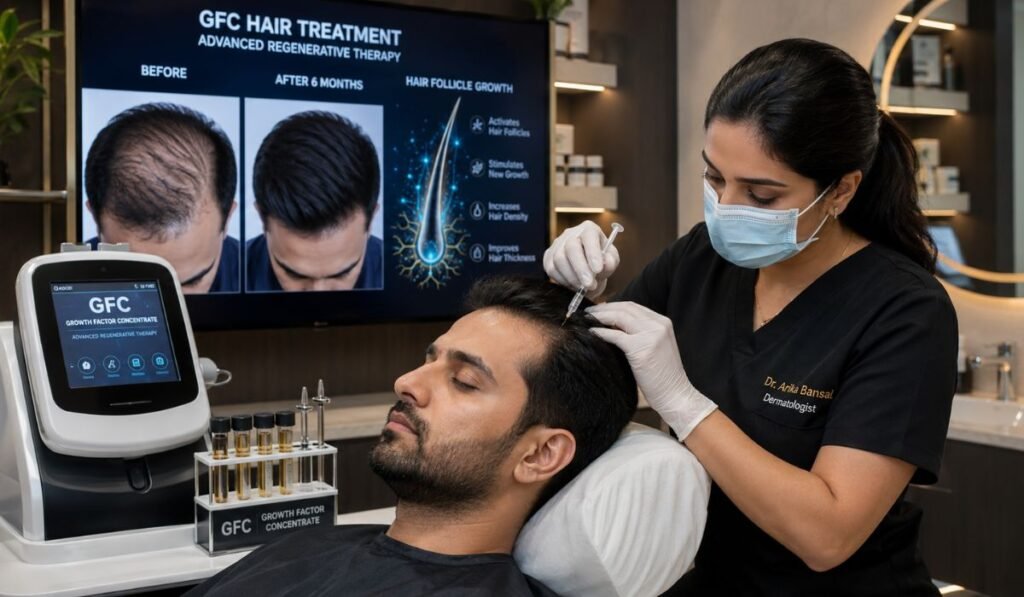
Step 2 — GFC Preparation in Specialised Kit (20 to 30 minutes) This is where GFC diverges completely from PRP. Instead of a standard centrifuge producing platelet-rich plasma, the blood is processed through a specialised GFC preparation system — a sealed kit containing activation agents that cause the platelets to release their growth factors into the surrounding solution. The kit then separates this pure growth factor solution from the cellular components, plasma proteins, and inflammatory mediators. The result is a clear, yellowish-to-golden solution containing only the concentrated growth factors — with no platelets, no red blood cells, and minimal plasma proteins remaining.
Step 3 — Scalp Numbing (20 minutes) Topical numbing cream applied across the treatment zone. GFC involves tiny injections into the scalp. A topical numbing cream is applied first. Most patients describe the feeling as mild tingling. Because GFC contains fewer inflammatory components than PRP, the post-injection burning sensation that some PRP patients experience is significantly reduced with GFC. ICICIdirect
Step 4 — GFC Injection (20 to 25 minutes) The prepared GFC solution is drawn into syringes and injected into the scalp using a fine needle or a mesotherapy gun — at 1 cm intervals across the thinning area, at 4 to 6 mm depth targeting the follicle bulge zone. The pure growth factor solution begins acting immediately upon contact with the follicle environment — unlike PRP, which requires the scalp’s own cellular processes to activate the platelets before growth factors are released.
Step 5 — Post-Treatment (5 minutes) Scalp cleaned. There is no downtime and you can return to work the same day. The absence of inflammatory plasma components means post-treatment redness and swelling — common with PRP — are minimal to absent with GFC for most patients. ICICIdirect
Total session time: 60 to 75 minutes — slightly shorter than PRP due to the more efficient preparation process.
GFC Hair Treatment Cost in India 2026 — Complete City-Wise Breakdown
GFC Hair Treatment The Complete India Guide
Because it is more advanced, the GFC hair treatment cost is higher. On average, the GFC treatment cost in India is between ₹7,000 to ₹15,000 per session. The total cost depends on the number of sessions recommended by your doctor, which usually ranges from 3 to 4 sessions. INDmoney
Per Session Cost by Clinic Tier:
| Clinic Type | GFC Cost Per Session | Notes |
|---|---|---|
| Mid-range specialist clinic | ₹7,000 – ₹10,000 | Standard GFC kit, qualified dermatologist |
| Premium dermatology centre | ₹10,000 – ₹15,000 | Advanced GFC system, trichologist |
| Top-tier cosmetic clinic | ₹15,000 – ₹20,000 | Premium GFC protocol, personalised treatment plan |
| Teaching hospital / academic centre | ₹6,000 – ₹10,000 | Research-grade protocols, resident supervision |
City-Wise GFC Cost Comparison:
| City | GFC Per Session Range | Full Protocol Range (3–4 sessions) |
|---|---|---|
| Delhi / NCR | ₹8,000 – ₹20,000 | ₹28,000 – ₹80,000 |
| Mumbai | ₹10,000 – ₹20,000 | ₹35,000 – ₹80,000 |
| Bangalore | ₹8,000 – ₹18,000 | ₹28,000 – ₹70,000 |
| Hyderabad | ₹7,000 – ₹15,000 | ₹25,000 – ₹60,000 |
| Chennai | ₹6,000 – ₹12,000 | ₹22,000 – ₹50,000 |
| Pune | ₹7,000 – ₹12,000 | ₹24,000 – ₹48,000 |
| Jaipur / Tier-2 cities | ₹6,000 – ₹10,000 | ₹20,000 – ₹40,000 |
The Smart Cost Comparison — GFC vs PRP Over 3 Years:
Yes, many surgeons use GFC for the primary course and switch to PRP for long-term maintenance. This approach gives the fast early results of GFC with the lower ongoing cost of PRP. ICICIdirect
| Protocol | Year 1 Cost | Year 2–3 Annual Cost | 3-Year Total |
|---|---|---|---|
| PRP only | ₹20,000–₹45,000 | ₹12,000–₹30,000 | ₹44,000–₹1,05,000 |
| GFC only | ₹30,000–₹60,000 | ₹10,000–₹20,000 | ₹50,000–₹1,00,000 |
| GFC initial + PRP maintenance | ₹30,000–₹60,000 | ₹8,000–₹20,000 | ₹46,000–₹1,00,000 |
The three-year total is remarkably similar. GFC costs more upfront but requires less frequent maintenance — making the long-term cost comparable to PRP. The GFC-initial-plus-PRP-maintenance protocol that top clinics are recommending in 2026 delivers the best of both: faster early results from GFC and lower-cost maintenance from PRP.
Success Rate and Results — What Clinical Data Actually Shows
GFC Hair Treatment The Complete India Guide
Clinical studies have shown amazing results with both types of treatments. The success rate of the GFC hair treatment is around 75 to 83% among different patients. Few of them start to see positive results from the first session onwards, while for others it would take at least two or three treatment sessions. Yahoo Finance
Timeline of GFC Results:
GFC Hair Treatment The Complete India Guide
- Session 1 (Month 1): Reduced hair fall — most patients notice significantly less hair in the shower and comb within 2 to 3 weeks of the first session. This is the fastest-appearing result of GFC and is often visible before the second session.
- Session 2 (Month 2): Scalp health improves — the scalp feels less oily or less dry (depending on the patient’s baseline), and existing hair appears thicker and shinier. The hair shaft diameter begins to increase.
- Session 3 (Month 3): Visible regrowth begins — fine baby hairs appear in areas of recent thinning. At the hairline and parting, the density begins to improve noticeably.
- Session 4 (Month 4, if recommended): Regrowth continues and thickens — the baby hairs from Month 3 gain diameter and length. The overall difference from pre-treatment photographs is now clearly visible.
- Month 6: Maximum initial results achieved — the clearest point for before-and-after assessment.
- Maintenance (every 6 to 12 months): Sustaining the results — GFC’s longer maintenance interval compared to PRP is one of its key practical advantages.
What GFC cannot do: GFC cannot regrow hair on a completely bald scalp where follicles are dead. It cannot reverse Grade 5 or higher Norwood baldness. It cannot replace the cosmetic coverage that a hair transplant provides for significant baldness. And it cannot deliver results without patience — the biological timeline of follicle reactivation is fixed by human physiology, not by the concentration of growth factors injected.
GFC Side Effects — The Complete Honest List
GFC Hair Treatment The Complete India Guide
Because GFC eliminates the inflammatory plasma components that cause most PRP side effects, its side effect profile is cleaner and shorter-duration than PRP.
Common and Expected (resolve within 12 to 24 hours): Mild scalp tenderness at injection sites. Occasional mild redness — significantly less than PRP in most patients. A sensation of scalp tightness for a few hours post-treatment.
Less Common (resolve within 48 to 72 hours): Very mild swelling — less common than with PRP due to the absence of inflammatory plasma proteins. The temporary shedding phase — as with PRP, some patients experience increased hair fall in weeks 2 to 4 after initial sessions as dormant follicles enter a new growth cycle. This is normal and self-resolving.
Rare: Infection at injection sites — extremely rare with proper sterile technique. No allergic reactions possible — GFC uses your own blood components exclusively.
The side effect nobody mentions: GFC kits require proper storage and handling — the specialised preparation kit is temperature-sensitive. A clinic that does not store and use the GFC kit properly may produce a solution with degraded growth factors that is both less effective and potentially more prone to causing irritation. This is why choosing a clinic that uses validated, properly stored GFC kits is non-negotiable — not just for results, but for safety.
Who Should Choose GFC Over PRP — The 6 Specific Scenarios
GFC Hair Treatment The Complete India Guide
Scenario 1 — You tried PRP and results were disappointing PRP still works well for people with early thinning or budget restrictions, but GFC provides significantly better results in both clinical studies and patient experiences. If you completed a full PRP protocol — minimum 4 sessions — and saw only partial results, GFC’s higher growth factor concentration may deliver the additional stimulus your follicles need. This is one of the most common reasons dermatologists recommend switching to GFC. Bajaj Finserv
Scenario 2 — You want faster results with fewer clinic visits GFC typically needs only 3 to 4 sessions for the primary course — compared to PRP’s 4 to 6 sessions. The full GFC protocol is shorter by about 2 months on average. For working professionals who cannot commit to 6 monthly clinic appointments, a 3 to 4-session GFC protocol that delivers faster visible results is a significantly better lifestyle fit. ICICIdirect
Scenario 3 — You have a sensitive scalp or inflammatory scalp conditions Because GFC eliminates the inflammatory plasma proteins present in PRP, it is the preferred option for patients with sensitive scalps, seborrheic dermatitis, or chronic scalp irritation. The purer growth factor solution causes minimal post-injection inflammation — making the treatment more comfortable and reducing the risk of triggering scalp flares.
Scenario 4 — You are preparing for or recovering from a hair transplant PRP is often used after hair transplant to keep hair healthy. Many surgeons use GFC for the primary course. In the pre-transplant phase, GFC is increasingly preferred by hair transplant surgeons because the higher growth factor concentration better prepares the scalp’s vascular environment for graft survival. Post-transplant, GFC sessions in months 1 and 3 improve graft survival rates and accelerate the timeline of transplanted hair growth. ICICIdirect
Scenario 5 — You have moderate hair loss and want the most efficient protocol For patients with Grade 3 to 4 androgenetic alopecia — beyond early thinning but not yet advanced baldness — GFC’s higher concentration gives it the ability to stimulate follicles that standard PRP concentrations may not adequately reach. This moderate-loss segment is where GFC most consistently outperforms PRP in clinical comparison.
Scenario 6 — You prefer longer gaps between maintenance sessions GFC’s maintenance interval of 6 to 12 months — compared to PRP’s 3 to 6 months — is a significant practical advantage for patients who find frequent clinic visits disruptive. One GFC maintenance session per year versus two to four PRP maintenance sessions per year is a meaningful lifestyle difference over a 5-year maintenance commitment.
Who Should NOT Choose GFC — 4 Honest Disqualifications
GFC Hair Treatment The Complete India Guide
Budget is a primary constraint. If the cost difference between GFC (₹30,000 to ₹60,000 for a full protocol) and PRP (₹20,000 to ₹45,000) is genuinely difficult to accommodate, PRP is the right choice. A complete PRP protocol delivers meaningful results for the majority of appropriate candidates — and is vastly better than no treatment at all. Do not take a bank loan for GFC when PRP is within your budget.
You have advanced baldness with no viable follicles. Neither GFC nor PRP can help. The investment — regardless of the growth factor concentration — will produce no results where follicles are absent. A hair transplant consultation is the appropriate next step, and GFC can then be used pre and post-transplant to optimise surgical outcomes.
The clinic offering GFC cannot explain their preparation system. GFC’s effectiveness is entirely dependent on the quality of the preparation kit and the technique of activation and extraction. If a clinic uses the word “GFC” but cannot specify which validated GFC system they use, how the platelets are activated, or what growth factor concentration their protocol achieves — they may be offering rebadged PRP at GFC prices. Ask specifically: “Which GFC preparation kit do you use? What is the platelet activation method?”
You are pregnant or breastfeeding. Both GFC and PRP are contraindicated during pregnancy and breastfeeding. Postpartum hair loss — which is extremely common and which GFC and PRP both address effectively — should be treated only after breastfeeding is complete and the doctor confirms treatment suitability.
The Smart 2026 Protocol — What Top Indian Clinics Are Actually Recommending
GFC Hair Treatment The Complete India Guide
Many surgeons use GFC for the primary course and switch to PRP for long-term maintenance. This approach gives the fast early results of GFC with the lower ongoing cost of PRP. ICICIdirect
The most clinically sophisticated protocol being recommended at leading trichology practices in India in 2026 is not GFC alone or PRP alone — it is a strategic combination.
Phase 1 — Initial Stimulation (Months 1 to 4): GFC 3 to 4 GFC sessions at monthly intervals. The higher growth factor concentration delivers faster follicle stimulation, earlier visible results, and a stronger initial reactivation of dormant follicles. The patient sees meaningful improvement within the first protocol.
Phase 2 — Consolidation (Months 5 to 8): Optional PRP bridge For patients with significant ongoing hair loss, 1 to 2 PRP sessions during the post-GFC period maintain the growth stimulus while the follicles consolidate their new activity patterns.
Phase 3 — Maintenance (Every 6 to 12 months): GFC or PRP based on response Patients who responded strongly to GFC continue with annual GFC maintenance sessions. Patients who achieved adequate results continue with twice-yearly PRP maintenance at lower cost. The choice depends on individual response, maintenance budget, and the dermatologist’s assessment of ongoing hair loss activity.
This combined protocol costs approximately ₹40,000 to ₹75,000 in Year 1 and ₹10,000 to ₹20,000 annually for maintenance — delivering the best results at a total cost that is competitive with either treatment used exclusively.
GFC at Home — The Dangerous Trend to Avoid
GFC Hair Treatment The Complete India Guide
In 2026, some online platforms and social media accounts are promoting “at-home GFC kits” — DIY blood-processing systems that claim to allow GFC preparation without clinic visits. This trend is dangerous and must be addressed directly.
GFC requires:
- Sterile blood draw technique — improper technique causes infection, nerve damage, or hematoma
- Medical-grade centrifuge and activation systems — consumer-grade alternatives produce inconsistent and potentially unsafe preparations
- Injection into the scalp at precise depth — improper depth causes ineffective treatment or scalp trauma
- Post-procedure monitoring — adverse reactions require immediate medical intervention
There is no safe, effective at-home GFC treatment. Any platform selling this concept is prioritising commercial gain over patient safety. GFC must be administered by a qualified dermatologist or trichologist in a clinical setting with sterile equipment and emergency response capability.
5 Real Patient Scenarios — GFC in Practice
GFC Hair Treatment The Complete India Guide
Scenario 1 — 30-year-old male, early androgenetic alopecia, high-stress lifestyle A Bangalore-based software engineer with Grade 2 Norwood hairline recession and thinning at the crown. He travels frequently for work and cannot commit to monthly PRP sessions. His dermatologist recommends a 3-session GFC protocol — sessions in Month 1, Month 2, and Month 3 — followed by a GFC maintenance session every 8 months. Total Year 1 cost: ₹42,000 at a premium Bangalore clinic. By Month 4, hairline recession has stabilised and crown density has measurably improved. He requires only one annual maintenance session — fitting cleanly into his work schedule.
Scenario 2 — 38-year-old woman, post-PRP non-responder A Delhi-based teacher completed 5 PRP sessions over 6 months at a mid-range clinic. Results were modest — reduced shedding but minimal regrowth. Her trichologist recommends switching to GFC. After 3 GFC sessions at a premium clinic using a validated GFC preparation system, she sees clear new growth at the parting and hairline by Month 4. The higher growth factor concentration overcame the partial PRP resistance her follicles had shown.
Scenario 3 — 45-year-old man pre-hair transplant A Mumbai businessman with Grade 4 Norwood baldness is scheduled for an FUE hair transplant in 3 months. His surgeon recommends 2 GFC sessions — one 6 weeks before surgery and one 6 weeks after — to improve scalp vascularity pre-transplant and graft survival post-transplant. GFC cost: ₹28,000 for 2 sessions. The transplant surgeon reports above-average graft survival rates in patients who complete the GFC protocol.
Scenario 4 — 26-year-old woman with seborrheic dermatitis and hair loss A Hyderabad-based designer has both significant dandruff-related scalp inflammation and progressive hair thinning. PRP was recommended by one clinic — but a second opinion from a trichologist recommends GFC specifically because the absence of inflammatory plasma components makes it safer and more comfortable for her chronically irritated scalp. After 4 GFC sessions alongside medicated shampoo treatment, both the scalp inflammation and the hair loss improve simultaneously.
Scenario 5 — 33-year-old man on a careful budget A Chennai-based teacher with early thinning wants GFC but finds the ₹10,000 per session cost at premium clinics difficult to sustain for the full protocol. His dermatologist recommends 3 GFC sessions at a mid-range specialist clinic at ₹7,000 per session — total initial cost ₹21,000 — followed by twice-yearly PRP maintenance at ₹5,000 per session. The GFC-initial plus PRP-maintenance hybrid delivers strong initial results while keeping annual maintenance cost at ₹10,000 — comfortably within his budget.
6 Questions to Ask Before Your First GFC Session
GFC Hair Treatment The Complete India Guide
“Which GFC preparation kit do you use?” Validated, CE-marked or USFDA-cleared GFC kits — such as RegenKit, Regen BCT, or equivalent systems — are the standard of care. Generic or unvalidated kits produce inconsistent growth factor concentrations.
GFC Hair Treatment The Complete India Guide
“What is the platelet activation method in your GFC protocol?” Calcium chloride activation versus thrombin activation versus tube-based activation produce different growth factor profiles. A clinic that cannot answer this question does not fully understand what they are preparing.
GFC Hair Treatment The Complete India Guide
“How many GFC sessions are you recommending for my specific case — and why?” The answer should be based on your individual hair loss stage, scalp health, and medical history — not a standard package.
GFC Hair Treatment The Complete India Guide
“What results can I realistically expect, and by when?” Any clinic that promises dramatic results within 4 weeks, or guarantees complete hair restoration for advanced baldness, is misrepresenting what GFC can deliver. Honest expected outcomes: reduced shedding within 2 to 3 weeks, improved density visible from Month 3, maximum results at Month 6.
GFC Hair Treatment The Complete India Guide
“Will I need maintenance sessions after the initial protocol — and at what frequency?” GFC typically requires maintenance every 6 to 12 months. Understanding the long-term commitment and cost before starting is essential for realistic planning.
GFC Hair Treatment The Complete India Guide
“What concurrent treatments do you recommend alongside GFC?” Minoxidil topical, finasteride (for appropriate male patients), micronutrient supplementation, and low-level laser therapy can all complement GFC results. A dermatologist who recommends GFC in isolation without discussing these adjuncts is not optimising your treatment plan.
Smart Tips — Getting the Maximum Results From GFC
GFC Hair Treatment The Complete India Guide
Combine GFC with minoxidil for synergistic results. Topical minoxidil (5% for men, 2% to 5% for women) extends the anagen growth phase and increases blood flow to follicles — complementing GFC’s growth factor stimulation. The combination consistently outperforms either treatment alone.
GFC Hair Treatment The Complete India Guide
Do not evaluate results before Month 3. The biological timeline of follicle reactivation cannot be accelerated by impatience. Month 3 is the earliest meaningful checkpoint for GFC results. Evaluating before this point and concluding treatment is not working leads to the most common GFC failure mode: abandonment before efficacy.
GFC Hair Treatment The Complete India Guide
Address nutritional deficiencies simultaneously. As covered in our PRP hair treatment guide, low ferritin, thyroid dysfunction, and PCOS-related hormonal imbalance all reduce the effectiveness of biological hair treatments including GFC. Blood tests and concurrent nutritional or hormonal treatment significantly improve GFC outcomes.
GFC Hair Treatment The Complete India Guide
Protect treated scalp from sun exposure for 48 hours. Direct sun exposure on a freshly treated scalp can cause excessive inflammation at injection sites. Wear a hat or use a gentle SPF when outdoors in the 48 hours following each GFC session.
GFC Hair Treatment The Complete India Guide
Take progress photographs at consistent intervals. The gradual nature of GFC results means that improvement is often missed without photographic comparison. Photograph your scalp from the same angles in the same lighting on Session 1 day, Month 3, and Month 6. The difference between before and after is almost always more significant than it appears day-to-day.
GFC Hair Treatment The Complete India Guide
Choose your clinic based on qualification, not price. The most expensive GFC session in your city is not automatically the best. The least expensive is not automatically inferior. The differentiating factors are: qualified doctor administering treatment, validated GFC kit, proper blood handling, and a clinic that conducts pre-treatment blood investigations. These factors matter more than the premium of the clinic’s location or interior design.
GFC Hair Treatment The Complete India Guide
Find a Qualified GFC Provider
GFC Hair Treatment The Complete India Guide
- Dermatologist verification: nmc.org.in (National Medical Commission register)
- IADVL qualified dermatologists: iadvl.org
- NABH-accredited clinics: nabh.co
- Trichological Society of India: trichologicalsocietyofindia.com
Disclaimer: This article is for informational and educational purposes only. GFC treatment results vary significantly based on individual hair loss stage, underlying medical conditions, clinic quality, preparation system used, and treatment compliance. This article does not constitute medical advice. Always consult a qualified dermatologist or trichologist before beginning any hair loss treatment. The cost ranges mentioned are approximate and may vary based on your specific city, clinic, and treatment protocol.