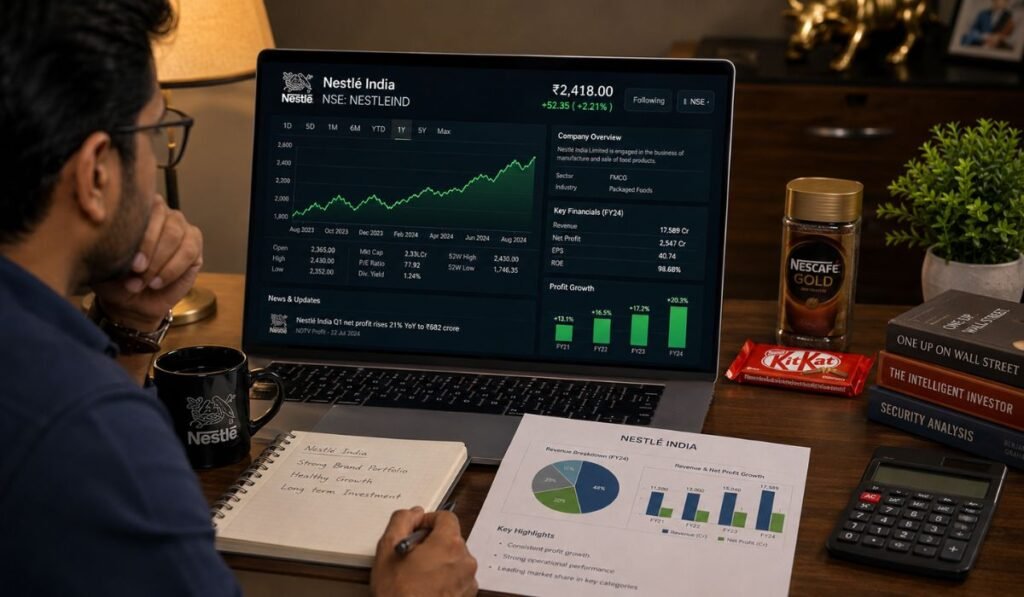
Nestle India Share Price Today
In India’s FMCG sector — where most companies have spent the last 12 months battling urban consumption slowdowns, rural distress, and margin pressure — one company has done exactly the opposite. Nestle India posted its highest-ever quarterly domestic sales in Q4 FY26. It grew revenue by 23%, profit by 27%, and expanded EBITDA margins to 26.3% — all while simultaneously increasing advertising spend by more than 50%. The stock has delivered 27% returns in one year, hit a fresh all-time high in early May 2026, and now trades at a P/E of 81x — a premium that either reflects India’s best consumer franchise or the most expensive biscuit in the room, depending on which analyst you ask.
If you are tracking Nestle India share price today, wondering whether MAGGI, KITKAT, and NESCAFÉ justify that valuation — or whether the stock has simply run too far, too fast — this is the complete article you need before forming any view.
Nestle India Share Price Today — Live Snapshot (May 2026)
Nestle India Share Price Today
| Metric | Value |
|---|---|
| Current Price (NSE: NESTLEIND) | ₹1,476–₹1,496 |
| Day High / Low | ₹1,496.30 / ₹1,470.00 |
| 52-Week High | ₹1,498.10 (May 11, 2026) |
| 52-Week Low | ₹1,084.70 |
| Market Cap | ~₹2,85,853 Cr |
| P/E Ratio | ~81.30x |
| P/B Ratio | ~55.19x |
Prices as of May 8–11, 2026. 50 DMA: ₹1,290.68 | 200 DMA: ₹1,247.69 | EPS FY26: ₹18.15 | Final Dividend: ₹5/share (Record Date: July 10, 2026) | 6-Month Return: +17.64% | 1-Year Return: +27.04%
What Is Nestle India? — The 70-Year Swiss-Indian Love Story
Nestle India Share Price Today
Nestle India Limited (NSE: NESTLEIND, BSE: 100790) is one of India’s most iconic and consistently profitable consumer companies — a subsidiary of Nestle S.A., the Swiss multinational that is the largest food and beverage company in the world. Incorporated in 1956 and listed on Indian exchanges since November 1994, Nestle India is headquartered in New Delhi and is led by CMD Manish Tiwary. Tracxn
The company’s business portfolio spans four key segments: Milk Products and Nutrition, Prepared Dishes and Cooking Aids, Powdered and Liquid Beverages, and Confectionery. Its iconic brand portfolio includes NESCAFÉ, MAGGI, MILKYBAR, KITKAT, BAR-ONE, MILKMAID, NESTEA, MUNCH, and CERELAC, among others. Tracxn
The numbers behind the brand strength are staggering. Maggi dominates the instant noodles segment with an estimated market share exceeding 60%, while Nescafé maintains leadership in the instant coffee category. And in a notable global milestone, India has become the second-largest market globally for the KITKAT brand — a significant climb from tenth position just a decade ago. UnityUnity
Nestle S.A. holds a 62.8% promoter stake, which has remained unchanged through FY26 — a signal of long-term conviction in the India growth story from the Swiss parent. Tracxn
Q4 FY26 Results — A Blockbuster That Beat Every Estimate
Nestle India Share Price Today
The March 2026 quarter was not just Nestle India’s best-ever quarterly performance — it was a comprehensive beat on every single metric that analysts track.
Consolidated net profit jumped 27.18% year-on-year to ₹1,110.9 crore from ₹873.46 crore in Q4 FY25. Revenue from operations surged 22.60% to ₹6,747.79 crore from ₹5,503.88 crore. This performance significantly beat analyst estimates, which had projected revenue of ₹6,230–₹6,370 crore and PAT of ₹990–₹1,010 crore. BSE
The result was powered by double-digit, volume-led growth — achieved alongside a greater-than-50% increase in advertising and promotional spends — while delivering a healthy EBITDA margin of 26.3%. This combination — more spending on advertising AND better margins — is exceptionally rare in FMCG and reflects the operating leverage that Nestle’s scale and brand equity generates. BSE
Domestic sales breached ₹6,445 crore — the highest ever recorded in a single quarter by the company. Abhipedia
For the full year, net profit rose 9.09% to ₹3,499.08 crore in FY26 compared to ₹3,207.59 crore in FY25. Sales rose 14.91% to ₹23,071.46 crore versus ₹20,077.50 crore in FY25. PitchBook
On cash generation, Nestle generated ₹5,047.6 crore in cash in FY26 — a sharp improvement over FY25’s ₹2,934.5 crore — reflecting working capital discipline and real profitability, not just paper profits. Tofler
The Volume-Led Growth Story — Why This Quarter Was Different
Nestle India Share Price Today
The most important single detail in Nestle India’s Q4 FY26 result is not the profit number or the revenue number. It is the nature of the growth. Nestle India delivered 23% year-on-year growth in Q4 FY26 with implied volumes of 18% year-on-year — indicating that the recovery was volume-led, not pricing-led. Wikipedia
In India’s competitive FMCG landscape, volume growth is the gold standard of brand health. Price-led growth is temporary — a company can raise prices once or twice, but the volume base eventually catches up. Volume-led growth means real consumers are buying more Maggi noodles, more KitKat bars, and more Nescafé sachets every single quarter. That is the growth that compounds.
The recovery appears to be led by underlying demand and distribution gains rather than pricing or base effects. The gains remain broad-based across categories and channels, with continued traction in general trade and rural markets, reflecting stronger execution and distribution depth. Wikipedia
The advertising investment story deserves special attention. Most FMCG companies, when facing input cost pressures, cut advertising first. Nestle did the opposite — it increased A&P by over 50% in Q4 FY26. This is a management team investing aggressively in brand equity at the exact moment competitors are pulling back. The result: market share gains across multiple categories in a single quarter.
The RURBAN Strategy — Nestle’s Rural Playbook
Nestle India Share Price Today
One of the most underappreciated structural drivers in the Nestle India story is its RURBAN strategy — a deliberate, infrastructure-heavy push to expand rural distribution at a time when most premium FMCG companies are focused almost entirely on urban and premium channels.
Nestle India has expanded its rural presence to 216,000 villages while simultaneously dominating the Quick Commerce premium space — a combination that most FMCG players have struggled to execute simultaneously. The rural presence is not just about distribution — it is about building brand familiarity in markets where Nestle’s products were previously unavailable or unaffordable. Abhipedia
The company’s comprehensive RURBAN strategy focuses on infrastructure and technology to strengthen distribution reach in India’s smaller towns and villages. Management has repeatedly flagged rural expansion as a key growth lever — and the Q4 FY26 results suggest that investment is now paying off in measurable volume growth. Unity
India’s rural markets — with rising incomes driven by PM-Kisan transfers, good rabi crop output, and government welfare spending — represent the single largest untapped consumer opportunity in the country. Nestle, through RURBAN, is positioning itself to capture a disproportionate share of that opportunity over the next decade.
Key Financial Metrics — Snapshot
Nestle India Share Price Today
| Metric | Value (May 2026) |
|---|---|
| Share Price (NSE) | ₹1,476–₹1,496 |
| Market Cap | ~₹2,85,853 Cr |
| P/E Ratio | ~81.30x |
| P/B Ratio | ~55.19x |
| Q4 FY26 Revenue | ₹6,747.79 Cr (+22.6% YoY) |
| Q4 FY26 PAT | ₹1,110.9 Cr (+27.18% YoY) |
| Q4 FY26 EBITDA Margin | 26.3% (+85 bps YoY) |
| FY26 Annual Revenue | ₹23,071.46 Cr (+14.91% YoY) |
| FY26 Annual PAT | ₹3,499.08 Cr (+9.09% YoY) |
| FY26 Operating Cash Flow | ₹5,047.6 Cr (+72% YoY) |
| EPS FY26 | ₹18.15 |
| ROE (3-Year) | 92.3% |
| ROCE | 92.46% |
| Promoter Holding | 62.8% (Nestle S.A.) |
| Final Dividend | ₹5/share (Record: July 10, 2026) |
| 1-Year Return | +27.04% |
Nestle India Share Price Target 2026 — What Analysts Are Saying
Nestle India Share Price Today
Post the Q4 FY26 beat, analyst upgrades have been swift and broad-based — but the premium valuation continues to divide opinion.
ICICI Securities raised its earnings estimate by 8.7% and 6.9% for FY27 and FY28 respectively, modeling revenue, EBITDA, and adjusted PAT CAGRs of 13%, 14%, and 14% respectively over FY26–FY28. The brokerage maintains a Buy with a revised DCF-based target price of ₹1,650 (raised from ₹1,550). Wikipedia
Axis Securities maintains a Buy rating with a target price of ₹1,640 — implying approximately 11–19% upside from the current trading range — citing the company’s long-term prospects, GST 2.0 consumption impulse, and structural levers including rural penetration and 125 product launches over the past seven years. X
The commodity outlook is also constructive. Coffee prices continue to trend lower, supported by a favourable crop in Vietnam and the upcoming crop in Brazil. Cocoa prices also remain subdued, reflecting improved supply and moderated demand. For a company where coffee and cocoa are two of the most significant input costs, this is a material tailwind that could support margin expansion into FY27 even without pricing action. Wikipedia
The Bonus Share — A Context Note for New Investors
Nestle India Share Price Today
One number in the snapshot deserves clarification. In August 2025, Nestle India issued a 1:1 bonus share — doubling the share count and halving the price on a per-share basis. This is why the share price appears to be in the ₹1,400–₹1,500 range rather than the ₹2,500+ levels that longer-term investors may remember. The market cap and fundamentals are unchanged — but new investors comparing current price data to pre-August 2025 charts need to account for this adjustment. Tofler
Risks Every Investor Must Understand
Nestle India Share Price Today
Nestle India’s quality is beyond question. But at a P/E of 81x and P/B of 55x, the risks are almost entirely valuation risks — and they deserve serious consideration.
Key risks flagged by analysts include: margin compression if EBITDA falls below 24%, which would indicate inability to pass through input cost inflation; volume deceleration to single-digit growth indicating market share loss or demand weakness; and valuation compression where the P/E multiple contracts toward 65–70x due to sector rotation or growth concerns. Tracxn
Input cost volatility remains the perennial risk. While coffee and cocoa prices are currently benign, milk prices — which directly affect the Nutrition and Dairy segments — have been trending upward in India. Any reversal in coffee and cocoa pricing would pressure the margin trajectory that the market is currently pricing in optimistically.
Competitive pressures from HUL, ITC, and regional players who are targeting the exact same rural distribution channels that Nestle is investing in through RURBAN could force the company to sacrifice margins for volume defence in select markets. Unity
Nestle India Share Price Today
And then there is the unavoidable valuation reality. At 81x earnings, Nestle India is one of the most expensive FMCG stocks in Asia. Any global risk-off event, any FII selloff in India, or any single quarter of below-expectation performance could trigger a sharp derating — even if the underlying business continues to perform well.
The Bull Case — Why Long-Term Investors Keep Holding
Nestle India Share Price Today
Despite the valuation, the bull case for Nestle India as a generational wealth compounder is built on foundations that very few Indian companies can match.
The company maintains exceptional return ratios — ROE of 66.55% and ROCE of 92.46% — a virtually debt-free balance sheet, and healthy long-term sales growth of 10.42% CAGR. A business that earns 92% return on capital employed and is virtually debt-free does not need cheap valuation to justify ownership — it justifies premium pricing precisely because it generates extraordinary returns on every rupee deployed. Unity
Nestle India Share Price Today
The brand portfolio — Maggi, Nescafé, KitKat, Milkmaid, Cerelac — represents decades of trust built in Indian households across every income bracket. These are not brands that can be disrupted overnight by a new entrant or a private label product. They are category-defining franchises.
The long-term outlook remains constructive, supported by a favourable demand environment and the positive consumption impulse expected from GST 2.0 reforms. The company’s growth strategy is anchored around multiple structural levers: deeper rural penetration and market share gains through the RURBAN strategy, and a sustained focus on innovation with 125 product launches over the past seven years. X
Should You Buy, Hold, or Wait on NESTLEIND Stock?
Nestle India Share Price Today
Long-term investors: Nestle India at ₹1,476–₹1,496 is as close to a 52-week high as it has ever been — and the business deserves it. For investors with a 5–10 year horizon and the ability to stomach premium valuations, this remains one of India’s best FMCG compounders. The volume-led growth trajectory, rural expansion, and commodity tailwinds all point to FY27 being at least as strong as FY26.
Short-term traders: The stock is trading within ₹15 of its all-time high of ₹1,498. Near-term upside is capped until the next earnings catalyst. The ₹1,250–₹1,300 zone — near the 50 DMA and 200 DMA — would be a more attractive entry for short-term positioning.
SIP investors: Nestle India is one of the finest candidates for long-term stock SIP on platforms like INDmoney or Dhan. The 1:1 bonus share in August 2025 has made the stock more accessible at post-bonus prices, and systematic monthly accumulation over 3–5 years effectively neutralises the entry timing risk at current premium valuations.
How to Buy Nestle India Shares
Nestle India Share Price Today
Open a Demat and Trading account with any SEBI-registered broker — Zerodha, Groww, Dhan, INDmoney, Kotak Neo, or Angel One. Search for NSE ticker NESTLEIND or BSE code 100790. Place a market order, limit order, or set up a monthly stock SIP. The record date for the final dividend of ₹5 per share is July 10, 2026 — investors who want to capture this dividend need to be on the register before that date.
Disclaimer: This article is for informational and educational purposes only. Share prices, analyst targets, and financial data are sourced from publicly available information as of May 2026 and are subject to change. This does not constitute investment advice. Please consult a SEBI-registered financial advisor before making any investment decisions. Past performance is not indicative of future returns.