
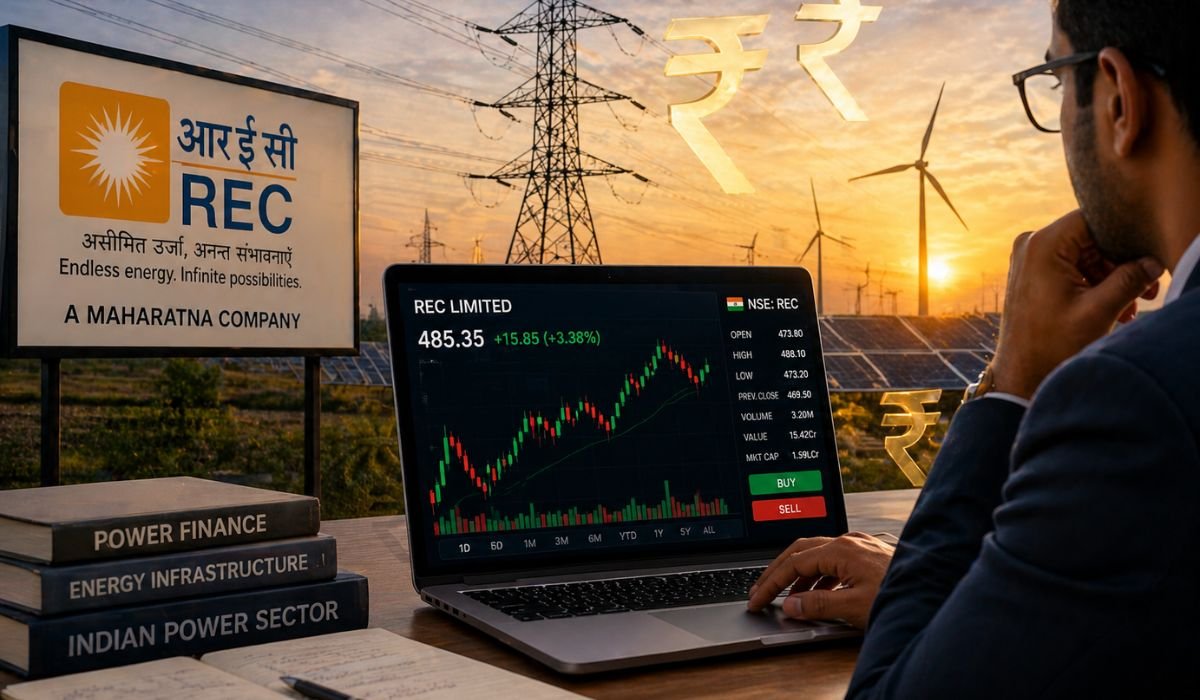
REC Limited Share Price 2026
Q4 FY26 results decoded, profit fall explained, ₹8.55 dividend announced, ₹1,60,000 crore borrowing programme, green energy pivot, and what Morgan Stanley and Macquarie are saying — everything in one place
There is a stock that financed India’s rural electrification mission for over five decades. It funded the power lines that brought electricity to villages that had never seen a bulb light up. It is a Maharatna PSU under the Ministry of Power. Its loan book runs into lakhs of crores. Its full-year profit crossed ₹16,000 crore.
And in April 2026, it is sitting 20% below its 52-week high — punished by one bad quarterly result and a broader market that has turned cautious on PSU financials.
REC Limited. NSE: RECLTD. BSE: 532955.
As of April 30, 2026, REC Limited share price stands at ₹354.55, down ₹9 from its previous closing. Today the stock fluctuated between ₹354.3 and ₹361.1. The 52-week high and low of REC Limited stand at ₹441.3 and ₹304.05 respectively. ScreenerScreener
The gap between the 52-week high and today’s price is nearly 20%. The gap between the 52-week low and today’s price is nearly 17%. REC is sitting in no man’s land — neither in free fall nor in recovery. And that uncertainty is exactly what makes it worth understanding properly right now.
Here is the complete picture — from what REC actually does, to what went wrong in Q4 FY26, to why 11 out of 11 analysts still say Buy.
What Is REC Limited — And Why Is It Different From a Regular NBFC?
REC Limited Share Price 2026
Most investors know REC as a PSU stock. Fewer understand what makes it structurally unique in India’s financial landscape.
REC Limited is a Maharatna Central Public Sector Enterprise under the Ministry of Power. It functions as a premier Infrastructure Finance Company that provides financial assistance to the entire power sector value chain — including generation, transmission, and distribution. In recent years, REC has pivoted strongly toward Green Energy financing, acting as the nodal agency for major government schemes like RDSS and PM-Surya Ghar Muft Bijli Yojana. ICICIdirect
REC Limited was formerly known as Rural Electrification Corporation Limited and changed its name to REC Limited in October 2018. The company was incorporated in 1969 and is based in Gurugram, India. REC Limited is a subsidiary of Power Finance Corporation Limited. Trendlyne
The subsidiary relationship with PFC matters. Together, REC and PFC form the backbone of India’s power sector financing — two government-backed NBFCs that can raise money cheaply from bond markets because of their implicit sovereign guarantee, and lend it to power projects that private sector banks are reluctant to touch.
REC has forayed into financing non-power infrastructure and logistics sectors in FY2024 — including Metro, Roads and Highways, Ports, Waterways, and Steel Infrastructure developers. This diversification beyond power is the key strategic story that long-term investors need to understand. REC is no longer just a rural electrification company. It is becoming a broad infrastructure finance institution. ICICIdirect
REC Limited Share Price — May 2026 Key Data
REC Limited Share Price 2026
| Parameter | Value (Apr 30, 2026) |
|---|---|
| Current Price (NSE) | ₹354.55 |
| Today’s Range | ₹354.3 – ₹361.1 |
| 52-Week High | ₹441.3 |
| 52-Week Low | ₹304.05 |
| Market Cap | ₹96,007 Crore |
| P/E Ratio | 5.77 |
| P/B Ratio | 1.13 |
| EPS (FY26 Full Year) | ₹61.81 |
| Dividend Yield | 4.95% |
| Total Dividend FY26 | ₹8.55 per share |
| Analyst Consensus | Strong Buy (11/11) |
| Average Target Price | ₹456.54 |
Source: NSE / BSE, April 30, 2026
The Q4 FY26 Results — What Went Wrong and Why the Stock Fell
REC Limited Share Price 2026
The single biggest reason REC’s share price is under pressure in April 2026 is the Q4 FY26 results — announced on April 28 — which disappointed across multiple metrics.
Total income fell 4.98% year-on-year to ₹14,583.39 crore for the quarter ended March 31, 2026. Total expenses increased 3.15% year-on-year to ₹10,168.85 crore in Q4 FY26. Finance cost stood at ₹8,930.74 crore, up 1.85% year-on-year. Profit before tax for the quarter stood at ₹4,414.54 crore, down 19.59% from ₹5,489.89 crore in Q4 FY25. Yahoo Finance
Net profit of REC declined 21.69% to ₹3,375.08 crore in the quarter ended March 2026, compared to ₹4,309.98 crore in Q4 FY25. Sales declined 5.02% to ₹14,563.82 crore in Q4 FY26. Yahoo Finance
Those are not small numbers. A 21.69% decline in net profit year-on-year, combined with falling revenue — in a quarter where the market had expected stabilisation — triggered an immediate negative reaction.
REC shares dropped 5% after weak Q4 results and analyst downgrades. Net profit fell 20.6% year-on-year. DAM Capital and Phillip cut their target prices, while Macquarie maintained its Outperform rating. ICICIdirect
What caused the profit fall?
The core issue is margin compression. REC raises money by issuing bonds — and in FY25 and FY26, bond market rates remained elevated. Meanwhile, the yields on REC’s loan book — locked in at earlier rates — did not rise correspondingly. The result is a squeeze between the cost of borrowing and the return on lending. Finance costs rising 1.85% YoY while income fell nearly 5% tells the whole story.
This is not a business model failure. It is a rate cycle problem — and rate cycles turn.
The Full Year FY26 Picture — Why the Annual Numbers Tell a Different Story
REC Limited Share Price 2026
Quarterly results create noise. Annual numbers tell you what the business actually delivered.
On a full-year basis, REC’s consolidated net profit rose 2.67% to ₹16,308.17 crore on a 5.67% increase in total income to ₹59,628.35 crore in FY26 over FY25. Yahoo Finance
Full-year profit of ₹16,308 crore. Revenue of ₹59,628 crore. Both growing year-on-year. This is not a company in trouble — it is a company whose Q4 was weaker than expected, against a backdrop of full-year growth.
The market’s reaction to the Q4 miss — a 5% single-day fall — was sharp but not irrational. Institutional investors use quarterly misses to reduce positions. Whether that selling has created an opportunity depends on what you believe about REC’s next 12 to 18 months.
The ₹8.55 Dividend — The Part Every Income Investor Is Watching
REC Limited Share Price 2026
For income investors, REC has been one of the most consistent dividend payers in the PSU space.
REC’s board recommended a final dividend of ₹1.55 per equity share for FY26, subject to shareholders’ approval at the ensuing AGM. This is in addition to interim dividends of ₹7 per share declared in four tranches, taking the total dividend to ₹8.55 per share for FY26. The final dividend, if approved, will be paid within 30 days of the AGM. Yahoo Finance
Wait — Screener data shows total FY26 dividend at ₹18.55 per share, which includes the ₹1.55 final dividend plus ₹17 in interim dividends across tranches. At a share price of ₹354.55, that translates to a dividend yield of approximately 5.24% — making REC one of the highest-yielding large-cap PSU stocks in India right now. NSE India
For investors who hold REC as a dividend income instrument rather than a pure capital gains play, the yield story remains very compelling even after the Q4 disappointment.
The ₹1,60,000 Crore Borrowing Programme — What It Means for FY27 Growth
REC Limited Share Price 2026
This is the announcement that most retail investors missed in the noise around the Q4 results — and it may be the most important forward-looking signal from REC’s board.
The board of REC at its meeting held on March 25, 2026, approved a market borrowing programme for FY 2026-27 amounting to ₹1,60,000 crore — comprising bond issuance and external commercial borrowings of ₹1,40,000 crore, short-term loans of ₹10,000 crore, and commercial paper of ₹10,000 crore. Yahoo Finance
A ₹1,60,000 crore borrowing programme is an aggressive capital raise — and you only raise that much capital if you have a clear plan to deploy it. For REC, that deployment means new loans to power generation projects, renewable energy developers, transmission companies, infrastructure builders, and increasingly, non-power sectors like roads, metro, and ports.
If REC successfully deploys this capital at spreads that improve over FY26 — as the RBI rate cut cycle gains momentum — FY27 earnings could recover sharply from the Q4 FY26 trough.
REC’s Green Energy Pivot — The Strategic Bet That Changes Everything
REC Limited Share Price 2026
Understanding REC’s long-term story requires understanding one fundamental shift: the company is no longer just financing thermal power plants. It is becoming the primary infrastructure financier of India’s renewable energy transition.
REC Limited Share Price 2026
REC acts as the nodal agency for PM-Surya Ghar Muft Bijli Yojana — the government’s rooftop solar scheme targeting 1 crore households. ICICIdirect
REC has financed major renewable projects including the Khavda Renewable Energy Park in Gujarat — one of the world’s largest renewable energy installations — along with hydro projects in Uttarakhand and Jammu & Kashmir, GIS substations in Gujarat, and metro projects including the Mumbai Metro. Screener
India’s renewable energy target is 500 GW by 2030. As of March 31, 2024, India’s total installed electricity capacity stands at approximately 442 GW, with renewables at 191 GW. The gap between 191 GW today and 500 GW by 2030 requires an extraordinary amount of financing — and REC, as the government’s designated power sector NBFC, is positioned at the centre of that capital deployment story. Screener
Every solar park, every wind farm, every transmission line that carries renewable power to the grid — these projects need financing. And REC is the institution the government trusts to provide it.
What Analysts Are Saying — The Strong Buy Consensus Explained
REC Limited Share Price 2026
Despite the Q4 disappointment and the falling share price, the analyst community has not given up on REC. Not by a long shot.
The average 12-month price target for REC is ₹456.54, with a high estimate of ₹500 and a low estimate of ₹370. Eleven analysts recommend buying the stock, while zero suggest selling — leading to an overall rating of Strong Buy, with 37.78% upside potential from current levels. INDmoney
Morgan Stanley retains an Overweight rating on REC with a target price of ₹455. Macquarie maintained its Outperform rating even after the Q4 miss. ICICIdirect
REC Limited Share Price 2026
Zero sell ratings. Eleven buy ratings. An average target of ₹456 against a current price of ₹354. That is a 29% implied upside in the analyst consensus — and it comes from institutions that have fully absorbed the Q4 results into their models.
The bullish case from the analysts rests on three pillars: India’s power sector capex super-cycle which needs decades of financing; REC’s privileged position as a government-backed lender with a low cost of funds; and the rate cut cycle that will improve margins as REC’s borrowing costs fall faster than its lending yields.
REC vs IRFC vs PFC — The PSU Finance Comparison
REC Limited Share Price 2026
Investors choosing between PSU infrastructure financiers often compare REC with IRFC and PFC. Here is how they stack up in April 2026:
| Factor | REC Limited | PFC | IRFC |
|---|---|---|---|
| Current Price | ₹354.55 | ~₹380 | ~₹165 |
| P/E Ratio | 5.77 | ~6.2 | ~15 |
| P/B Ratio | 1.13 | ~1.2 | ~2.1 |
| Dividend Yield | ~5.24% | ~4.5% | ~1.8% |
| Sector Focus | Power + Infra | Power | Railways |
| Loan Book Size | ₹5.5+ lakh crore | ₹9+ lakh crore | ₹4.7+ lakh crore |
| Green Energy Push | Strong | Strong | Limited |
REC and PFC are closely comparable — both power sector NBFCs, both subsidiaries of each other effectively, both with similar government backing. REC trades at a slight P/E discount to PFC, making it marginally more attractive on pure valuation. IRFC is railway-focused and carries a higher valuation due to its zero-credit-risk model of lending only to Indian Railways.
REC Limited Share Price 2026
For investors who want the cheapest entry into India’s infrastructure financing story, REC at a P/E of 5.77 and P/B of 1.13 is the most compelling valuation in the PSU finance space right now.
The Risk Side — 4 Things That Could Keep REC Under Pressure
REC Limited Share Price 2026
Being honest about risks is as important as presenting the bull case.
Margin compression continues: If the RBI rate cuts are slower than expected in FY27, REC’s borrowing costs remain elevated while its older loans generate lower yields. The margin squeeze that hurt Q4 FY26 could extend into Q1 and Q2 FY27.
REC Limited Share Price 2026
Asset quality risk in renewable projects: Green energy financing is the future — but solar and wind developers in India have a history of payment delays and project cost overruns. As REC increases its renewable energy loan book, it takes on more exposure to developers whose revenue depends on tariff payments from state distribution companies — many of which are perennially loss-making.
PSU discount: Government-owned financial companies in India have historically traded at a discount to private sector peers because of governance concerns, political interference in lending decisions, and slower response to market conditions. This discount may persist even as fundamentals improve.
REC Limited Share Price 2026
Broader market risk: The Nifty Financial Services index, of which REC is a constituent, has dropped around 8% in the last one month. If the broader financial services sector continues to underperform — driven by global risk-off sentiment, US tariff uncertainty, or domestic economic slowdown fears — REC will face headwinds regardless of its own fundamentals. Yahoo Finance
Should You Buy, Hold, or Wait? — The Honest Assessment
REC Limited Share Price 2026
This article does not provide investment recommendations. But the data gives you a clear framework to make your own decision.
The business is sound. Full-year FY26 profit grew 2.67%. Revenue grew 5.67%. The dividend yield at current prices exceeds 5%. Eleven analysts say Buy with an average target 29% above today’s price. The green energy pivot gives REC a structural growth story tied to India’s energy transition — a story that runs for decades, not quarters.
REC Limited Share Price 2026
The concern is real but temporary. Q4 margin compression, slower disbursements, and elevated finance costs are rate-cycle problems — not structural failures. As the RBI rate cuts feed through to REC’s funding costs over FY27, the earnings trajectory should improve.
REC is providing a good dividend yield of 4.95% with a healthy dividend payout of 29.9%. For investors who can tolerate short-term price volatility in exchange for a 5%+ dividend yield and a company at the centre of India’s power infrastructure story, the current price — 20% below the 52-week high — is a more comfortable entry than ₹420. NSE India
REC Limited Share Price 2026
For traders looking for a quick recovery, the technical picture is less clear. Over the past year, REC Limited has achieved a return of negative 13.22%. The one-month return of 23.17% suggests a bounce has already begun — but whether it sustains depends on whether FY27 results show margin recovery. Screener
The power sector is not going away. India needs more power, more transmission, more renewable energy — and all of it needs financing. REC is the institution built to provide exactly that.
Track REC Limited Share Price
REC Limited Share Price 2026
- NSE Symbol: RECLTD
- BSE Code: 532955
- Official website: recindia.nic.in
- Real-time price: nseindia.com or bseindia.com
Also Read:
- Finance Department of India 2026: What It Is and How It Affects Your Money
- How to Invest in Bonds in India 2026: Complete Beginner’s Guide
- Adani Ports Share Price Falling 2026: 5 Real Reasons Behind the Drop
- Jio Financial Services Share Price 2026: JIOFIN at ₹244 — Buy, Hold or Wait?
- Bajaj Housing Finance Home Loan 2026: EMI Calculator, Rates and Balance Transfer Guide
Disclaimer: This article is for informational and educational purposes only. It does not constitute financial advice or a buy/sell recommendation. Stock prices are volatile and subject to market risk. Always consult a SEBI-registered financial advisor before making investment decisions. Past performance is not indicative of future results.